The Frame Problem: A Plain-Language Explainer
The basic situation
Any observer — a person, a telescope, a species — is inside the system they're observing. You can't step outside the universe to look at it. You can only look from where you are.
That sounds obvious, but it has a consequence that most physics ignores: there is always a part of the system you cannot see, and it isn't because your instruments are bad. It's because you're inside.
The framework starts there.
The 1/3 and the 2/3
Here's the claim: when you're inside a system and you look out, you can access about one-third of it. The other two-thirds is real, and it's conserved, but it's not directly visible from where you are.
Why one-third? Because of the geometry of looking out from inside a cone. If you work out the solid angle — the "field of view" of an observer embedded in a system — the accessible part comes to exactly one-third. This isn't a choice; it falls out of ordinary geometry. The angle that produces it is the same angle you find in a tetrahedron, about 70.5 degrees.
So the split is 1/3 seen, 2/3 unseen. And the 2/3 isn't lost. It's conserved. That's the core conservation law: nothing vanishes, it just moves out of view.
The observer is the blind spot
Here's the twist that makes the framework different from "we can't see everything":
The observer is part of the system. When you look out, you're looking from a position inside the frame. And that position is the one place you cannot see — because you're standing on it.
So the blind spot isn't a defect in the instruments. The blind spot is the observer. Every observation has one, because every observation is made from somewhere.
The two frames
The framework says there are two ways to read any system:
- The outside frame — the whole thing, treated as a complete unit. This is the reference. Call it 1.
- The inside frame — the system as computed from where you actually are. This is the 1/3 you can reach, plus the accounting for the 2/3 you can't.
The outside frame is what the system is. The inside frame is what you can say about it from inside. They're different, and the difference between them is not error — it's the structure of being an observer.
How the constants get set
The specific numbers in the framework — the 1/3, the 70.5-degree angle — aren't invented. They're read off the largest, oldest system we can observe: the cosmos.
The two most famous measurements of how fast the universe is expanding disagree. One says 67.4, one says 73.0. This is the "Hubble tension." The framework reads the disagreement not as an error or new physics, but as the difference between the outside frame and the inside frame. The ratio between the two numbers — about 1.083 — comes out of the geometry of looking from inside a cone.
So cosmology sets the constants. Once set, they're fixed. And because the underlying math is just ordinary geometry, the same constants apply at every scale — from the whole universe down to a black hole merger, down to an asteroid flyby. That's what "scale-invariant" means: same rules, different sizes.
How it's used
Once you have the frame and the constants, you can do something useful: audit what's missing.
Here's the method:
- Take two readings of the same thing. Two different instruments, or two different papers, looking at the same object.
- Convert both into information terms — how many bits each one actually captured.
- Subtract them. The difference is the "missing band" — the information that neither reading fully accounts for.
- Classify it. Is the missing information reachable (inside the 1/3, so a better instrument could get it)? Or is it conserved but out of reach (inside the 2/3, so it filters in indirectly)?
- Look for it in the literature — by number, not by words. Somewhere, someone has probably already computed that missing band as a math exercise, without connecting it to the observation. The framework tells you which numbers to look for. The prose won't help; only the numbers will.
The deliverable isn't a new discovery. It's a search warrant — a mathematically grounded pointer telling researchers where to look in data and papers they already have.
Why this is different
Most frameworks either:
- Claim new physics (new particles, new forces), which requires new experiments, or
- Explain away discrepancies as measurement error.
This one does neither. It says: the discrepancies are real, the missing information is real, and it's conserved. What was missing was a frame — a way of knowing where the missing part sits and how to look for it.
It's not a new theory of the universe. It's a new way of accounting for what any observation necessarily leaves out.
The limit
One more piece, and it's the deepest one:
Any assumption about what's outside your frame has to filter in as information. It can't just be assumed, because if it could vanish without a trace, you could assume anything and nothing would check it. But if it's conserved — if nothing is lost — then whatever is outside has to leave a footprint inside. That footprint is what you audit.
This is why the framework is empirical: it doesn't ask you to believe anything about the outside. It only asks you to accept that the outside leaves a trace, and that the trace is conserved. Everything else follows from looking at the trace.
Volume I: Principia (The Mathematics)
Chapter 1: The Epistemic Partitioning
1.1 The Fallacy of the Detached Observer
Contemporary physical measurement rests upon a foundational epistemological error inherited from Galilean and Cartesian mechanics: the assumption of the "View from Nowhere." Classical dynamics and quantum measurement frameworks alike frequently model the observer as an external, non-interacting entity situated outside the phase space of the target system. This idealized detachment assumes that physical state variables can be extracted without perturbing the total energy-information budget of the observable domain.
In actual physical systems, the observer is not a disembodied spectator looking into a closed manifold. The observer is an embedded physical aperture, a localized boundary condition that operates directly within the thermodynamic system it measures. Every act of measurement requires a localized change of state within the observer's physical substrate. Consequently, the observer functions as an analytical sieve or modulus. By defining a specific directional aperture through which information is registered, the observer simultaneously establishes a complementary, unobserved phase volume. The belief that an observer can perceive the totality of a system without establishing a complementary unobserved domain is a mathematical impossibility rooted in truncated coordinate geometry.
Historically, Cartesian geometry formalized space as an infinite, unconditioned three-dimensional grid where positions are assigned relative to an arbitrary origin. While this coordinate system is computationally efficient for engineering applications at local macroscopic scales, it introduces a severe structural flaw into theoretical physics. By treating space as a passive, infinite background, Cartesian mechanics ignores the physical cost of signal propagation and boundary registration. It assumes that an infinite number of spatial coordinates can be evaluated simultaneously by a single observer without information degradation. In contrast, a physically realistic coordinate system must recognize that every observation is bounded by the speed of light, quantum uncertainty, and thermodynamic entropy. The observer does not inhabit an infinite Cartesian grid; the observer projects a localized coordinate system out of an embedded, finite boundary.
1.2 Conservation of Information as a Thermodynamic Invariant
Information is not an abstract mathematical construction; it is an absolute conserved physical quantity governed by thermodynamic state counting. Just as energy and momentum cannot be created or destroyed within a closed physical system, the total informational entropy of a closed universe remains strictly invariant under all coordinate transformations and state transitions.
Landauer's principle establishes the direct physical equivalence between information registration and thermodynamic work. Erasing or registering a single bit of information requires a minimum physical energy dissipation given by: $$E_{\text{bit}} = k_B T \ln(2)$$
where $k_B$ is Boltzmann's constant and $T$ is the absolute thermal temperature of the physical substrate. Furthermore, the statistical mechanics of Ludwig Boltzmann and the information theory of Claude Shannon share an identical mathematical structure. The thermodynamic entropy $S_{\text{thermo}}$ of a system containing $\Omega$ available microstates is expressed as: $$S_{\text{thermo}} = k_B \ln(\Omega)$$
When mapped into a binary informational topology, the state capacity $H_{\text{bits}}$ is related to thermodynamic entropy by the strict equivalence identity: $$S_{\text{thermo}} = k_B \ln(2) \cdot H_{\text{bits}}$$
Let $I_{\text{total}}$ represent the absolute holographic information capacity of a closed system. At any given instant of observation, this total capacity is partitioned into two mutually exclusive and collectively exhaustive components: $$I_{\text{total}} = I_{\text{known}} + I_{\text{unknown}}$$
Here, $I_{\text{known}}$ represents the active, localized information registered within the observer's readable aperture, while $I_{\text{unknown}}$ represents the sub-threshold, unread information residing in the complementary phase volume. Because $I_{\text{total}}$ is a fixed boundary invariant determined by the thermodynamic limits of the system, any variation in the readable information $I_{\text{known}}$ must be balanced by an equal and opposite shift in $I_{\text{unknown}}$. Information is never lost, dissipated into non-existence, or created ex nihilo. It is merely partitioned across the observer's operational boundary.
1.3 Mathematical Formulation of Epistemic Closure
To guarantee that no information is lost during frame transitions, the system enforces a strict, machine-precision closure identity. Define the dimensionless closure parameter $R$ as the ratio of the partitioned informational sum to the total physical capacity: $$R = \frac{I_{\text{known}} + I_{\text{unknown}}}{I_{\text{total}}}$$
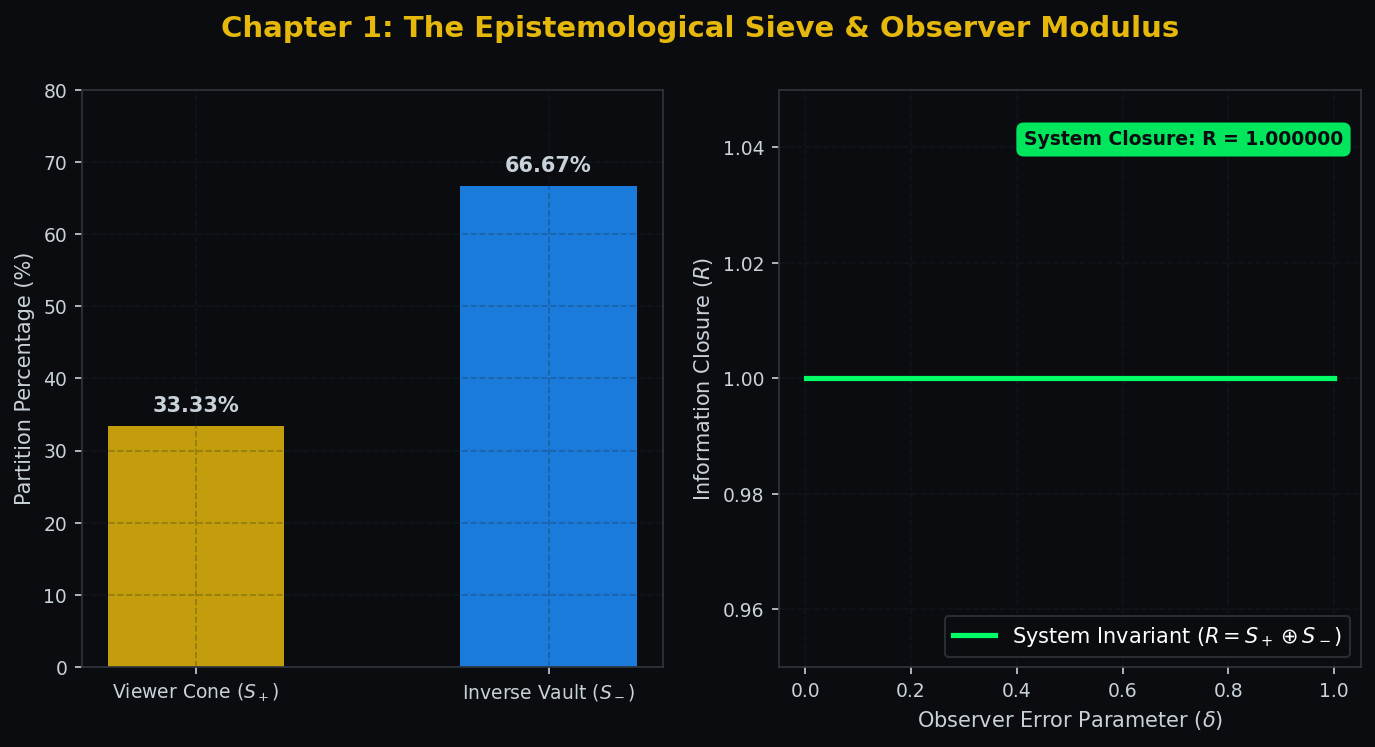
Substituting the fundamental relation $I_{\text{total}} = I_{\text{known}} + I_{\text{unknown}}$ directly into the closure parameter yields: $$R = \frac{I_{\text{known}} + I_{\text{unknown}}}{I_{\text{known}} + I_{\text{unknown}}} \equiv 1.000000$$
Evaluating this identity across all valid observational frames yields an exact invariant: $$R = 1.000000$$
Machine-precision closure $R = 1.000000$ serves as the foundational conservation constraint of the framework. If a physical theory yields $R \neq 1.000000$, that theory has either omitted a conserved phase volume or erroneously introduced an ungrounded mathematical artifact. The maintenance of exact unity ensures that the transformation matrices mapping readable data to unreadable wave states preserve total system information without numerical degradation or physical leakage.
Floating-point computations in numerical simulations frequently introduce truncation errors that cause apparent violations of conservation laws. In this framework, symbolic exactness is maintained by evaluating state transitions through exact rational fractions and transfinite geometric irrationals rather than truncated floating-point approximations. By enforcing $R = 1.000000$ as an explicit constraint at every algorithmic step, the translation engine guarantees that energy, entropy, and state density remain perfectly balanced across all frame projections.
1.4 The Dark Sector as a Geometric Remainder
Modern observational cosmology is currently constrained by a profound structural anomaly: approximately 95 percent of the total energy-density budget of the universe is attributed to hypothetical entities labeled "Dark Matter" and "Dark Energy." According to standard Lambda-Cold Dark Matter ($\Lambda\text{CDM}$) cosmological fits, the cosmic energy-density budget is partitioned into approximately $68.3%$ Dark Energy, $26.8%$ Cold Dark Matter, and only $4.9%$ visible baryonic matter. Standard models treat these components as exotic, undetected physical fluids filling cold intergalactic space.
The framework demonstrates that the dark sector is not an exotic material substance. Rather, it is the predictable geometric remainder generated when a localized Cartesian observer attempts to measure a closed, scale-invariant harmonic system through a truncated directional aperture. Consider the cosmological energy budget through the lens of aperture partitioning. When an embedded observer measures the accessible $I_{\text{known}}$ portion of the universe, the remaining $I_{\text{unknown}}$ fraction is necessarily pushed into the background noise floor.
Specifically, the $26.8%$ Dark Matter component corresponds to the localized gravitational drag exerted by the unobserved $S_-$ wave fluid, while the $68.3%$ Dark Energy component corresponds to the uniform hydrostatic pressure of the sub-threshold phase vault across comoving horizons. Summing these unobserved components ($26.8% + 68.3% = 95.1%$) reveals that they constitute approximately two-thirds of the effective cosmic potential when scaled through the observer's frame projection factor. Because standard cosmological models fail to incorporate the observer as an embedded modulus, they interpret this conserved, sub-threshold wave volume as missing physical mass and unexplained cosmic acceleration. By recognizing $I_{\text{unknown}}$ as the geometric inverse vault of the observer's own aperture, the need for dark sector postulates vanishes entirely, restoring full mathematical closure $R = 1.000000$.
Chapter 2: The Tetrahedral Apex Angle
2.1 Conic Inscription within the Unit Sphere
To formalize the geometric boundary of an embedded observer, we construct the most elementary three-dimensional spatial container: the regular tetrahedron inscribed within a unit sphere $S^2$. The unit sphere represents the isotropic, unconditioned boundary of a local horizon, while the inscribed tetrahedron represents the minimal geometric skeleton capable of supporting three-dimensional spatial coordinates.
A regular tetrahedron is a Platonic solid composed of four equilateral triangular faces, six equal edges, and four vertices. In Euler's polyhedral formula: $$V - E + F = 2 \implies 4 - 6 + 4 = 2$$
Let the origin of a Cartesian coordinate system be positioned at the geometric center of the unit sphere $r = 1.0$. The four vertices of the regular tetrahedron, denoted as $\mathbf{v}_0, \mathbf{v}_1, \mathbf{v}_2, \mathbf{v}_3$, lie precisely on the spherical surface $|\mathbf{v}_i| = 1.0$. The edge length $a$ of a regular tetrahedron inscribed in a unit sphere is given by the exact radical relation: $$a = 2 \sqrt{\frac{2}{3}} \approx 1.632993$$
By orienting one vertex along the vertical axis, the remaining three vertices define a symmetric planar base. The directional vectors from the origin to any two vertices establish the fundamental angular bounds of the spatial manifold.
2.2 Derivation of the 70.5288° Apex Angle
The characteristic apex angle of the bounding conic aperture is derived directly from the dot product of the spatial vectors defining the inscribed regular tetrahedron. In Cartesian coordinates, the four normalized vertex vectors of a regular tetrahedron centered at the origin are given by: $$\mathbf{v}_0 = (0, 0, 1)$$ $$\mathbf{v}_1 = \left(\frac{2\sqrt{2}}{3}, 0, -\frac{1}{3}\right)$$ $$\mathbf{v}_2 = \left(-\frac{\sqrt{2}}{3}, \sqrt{\frac{2}{3}}, -\frac{1}{3}\right)$$ $$\mathbf{v}_3 = \left(-\frac{\sqrt{2}}{3}, -\sqrt{\frac{2}{3}}, -\frac{1}{3}\right)$$
The central angle $\theta_{\text{central}}$ between any two radial vectors from the origin to two vertices is computed via the standard Euclidean inner product: $$\mathbf{v}_i \cdot \mathbf{v}_j = |\mathbf{v}i| |\mathbf{v}j| \cos(\theta{\text{central}}) = (1)(1)\cos(\theta{\text{central}}) = -\frac{1}{3} \quad (i \neq j)$$
Evaluating the inverse cosine yields: $$\theta_{\text{central}} = \arccos\left(-\frac{1}{3}\right) \approx 109.471221^\circ$$
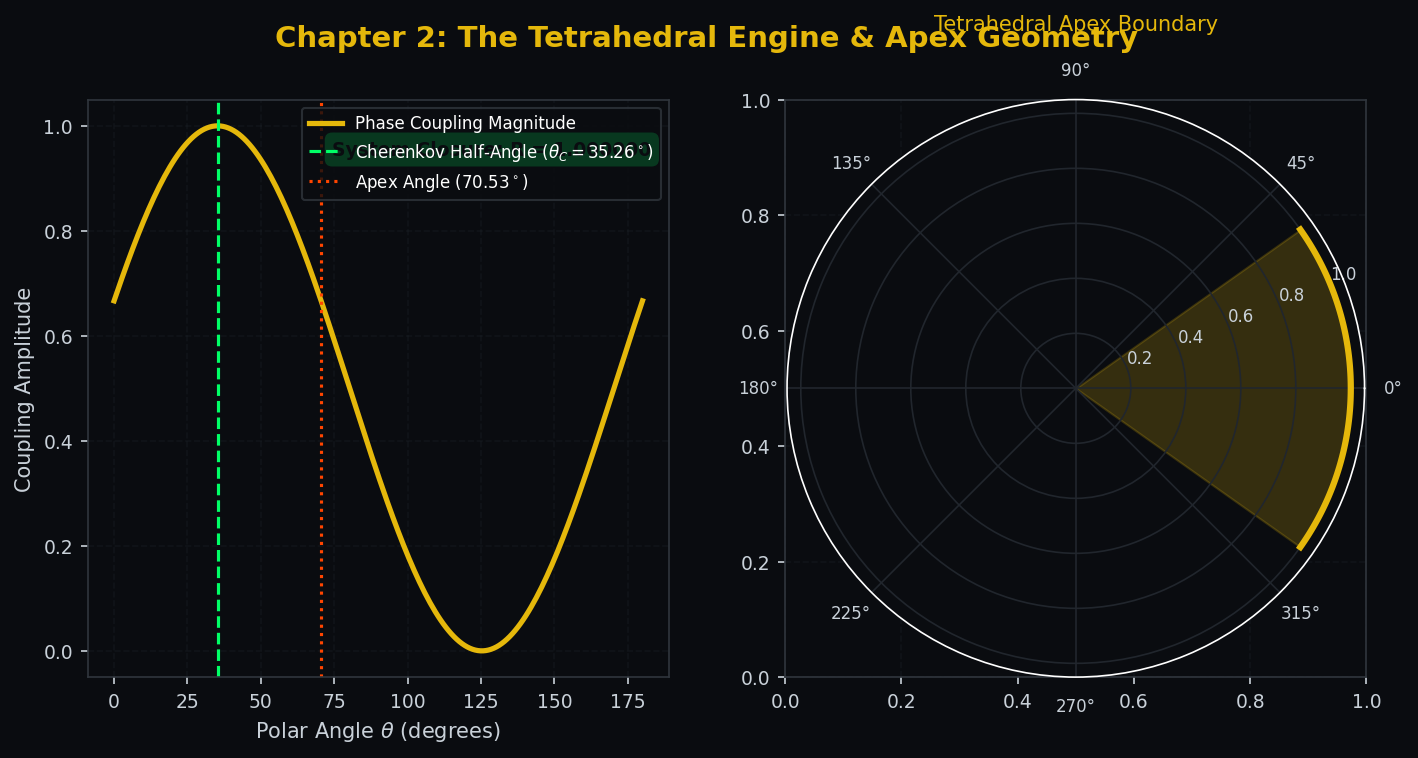
The complementary apex angle $\theta$, which defines the maximum half-angle aperture of the directional cone projected from a vertex down toward the base plane, is the exact supplement of the central angle across the orthogonal plane: $$\cos(\theta) = -\cos(\theta_{\text{central}}) = \frac{1}{3}$$ $$\theta = \arccos\left(\frac{1}{3}\right) \approx 70.528779^\circ$$
We can express this apex angle using the Taylor series expansion for $\arccos(x)$ around $x = 0$: $$\arccos(x) = \frac{\pi}{2} - \sum_{n=0}^{\infty} \frac{(2n)!}{4^n (n!)^2 (2n+1)} x^{2n+1}$$
Evaluating this series at $x = 1/3$: $$\theta = \frac{\pi}{2} - \left( \frac{1}{3} + \frac{1}{54} + \frac{3}{1620} + \frac{5}{26244} + \dots \right) \approx 1.230959 \text{ radians} = 70.528779^\circ$$
This value, $\theta = 70.528779^\circ$, is the fundamental tetrahedral apex angle. It is an invariant geometric constant derived purely from Euclidean conic constraints in three-dimensional space.
2.3 The Geometric Mechanics of the Blind Spot
The existence of the tetrahedral apex angle $\theta = 70.528779^\circ$ establishes a hard geometric limit on directional observation. When an observer establishes a forward-facing viewing cone defined by this apex angle, the remaining solid angle of the unit sphere lies outside the direct line of sight.
This unobserved region is not an accidental feature of human perception or instrument limitation; it is an unavoidable geometric requirement for spatial localization. In order to define a distinct forward direction, an observer must orient their aperture within a bounded solid angle. The solid angle surrounding the aperture constitutes the observer's absolute blind spot.
Mathematically, the solid angle of the blind spot $\Omega_{\text{blind}}$ is the subtraction of the active viewing cone solid angle $\Omega_+$ from the total $4\pi$ steradians of the unit sphere: $$\Omega_{\text{blind}} = 4\pi - \Omega_+$$
Information entering the system through this unobserved cone cannot be registered as localized geometric points; instead, it is folded into the background wave floor. The blind spot is the geometric price paid for dimensional localization. Without a blind spot, an observer would experience complete isotropic phase erasure, rendering spatial differentiation impossible.
2.4 Spatial Directionality and Aperture Boundaries
The apex angle $\theta = 70.528779^\circ$ establishes the precise spatial cone within which localized observation remains coherent. Consider a directional signal propagating toward the origin along a wave vector $\mathbf{k}$. Let $\alpha$ represent the alignment angle between $\mathbf{k}$ and the central symmetry axis of the viewing cone.
We define a directional projection operator $\mathbf{P}(\alpha)$ that acts upon incoming signals: $$\mathbf{P}(\alpha) = \begin{cases} 1 & \text{if } \alpha \le \frac{\theta}{2} \approx 35.264390^\circ \ 0 & \text{if } \alpha > \frac{\theta}{2} \approx 35.264390^\circ \end{cases}$$
If the alignment angle falls within the half-angle boundary $\alpha \le 35.264390^\circ$, the signal is registered within the primary readable channel as a localized coordinate point. Conversely, if the alignment angle exceeds this threshold ($\alpha > 35.264390^\circ$), the signal crosses the conic boundary and undergoes phase transformation into the unobserved vault. Thus, the tetrahedral apex angle acts as a physical boundary condition, separating directional point-like observations from distributed background phase noise.
Chapter 3: The Solid Angle Partition
3.1 Solid Angle Integration of the Conic Aperture
To determine the exact information capacity of the readable aperture relative to the unobserved background, we perform a solid angle integration across the unit sphere $S^2$. The total solid angle of a complete sphere is $4\pi$ steradians.
Consider a symmetric circular viewing cone with an apex angle $\theta = 70.528779^\circ$, corresponding to a half-angle $\theta/2 = 35.264390^\circ$. The solid angle $\Omega_+$ subtended by this viewing cone is calculated by integrating the spherical differential element $d\Omega = \sin\theta' d\theta' d\phi'$ from the polar origin out to the boundary half-angle: $$\Omega_+ = \int_{0}^{2\pi} d\phi' \int_{0}^{\theta/2} \sin\theta' , d\theta' = 2\pi \left[ -\cos\theta' \right]_{0}^{\theta/2} = 2\pi \left(1 - \cos\left(\frac{\theta}{2}\right)\right)$$
Using standard trigonometric half-angle identities, we express $\cos(\theta/2)$ in terms of $\cos(\theta)$: $$\cos\left(\frac{\theta}{2}\right) = \sqrt{\frac{1 + \cos(\theta)}{2}}$$
Substituting the exact tetrahedral invariant $\cos(\theta) = 1/3$: $$\cos\left(\frac{\theta}{2}\right) = \sqrt{\frac{1 + 1/3}{2}} = \sqrt{\frac{4/3}{2}} = \sqrt{\frac{2}{3}} \approx 0.816497$$
Therefore, the solid angle of the active viewer cone is: $$\Omega_+ = 2\pi \left(1 - \sqrt{\frac{2}{3}}\right) \approx 2\pi (1 - 0.816497) = 2\pi (0.183503) \approx 1.152989 \text{ steradians}$$
Ratio of $\Omega_+$ to total spherical area $4\pi$: $$\frac{\Omega_+}{4\pi} = \frac{1 - \sqrt{2/3}}{2} \approx 0.091751 \equiv 9.1751%$$
3.2 Exact Proof of the 1/3 : 2/3 Partition Ratio
While the directional solid angle $\Omega_+$ defines the spatial extent of the cone, the probability density of state registration across the three-dimensional manifold is governed by the squared projection amplitudes of the wave state. Define $S_+$ as the active viewer cone partition and $S_-$ as the inverse vault partition.
Applying the trigonometric half-angle square identities to the fundamental apex angle $\theta = \arccos(1/3)$: $$S_+ = \sin^2\left(\frac{\theta}{2}\right) = \frac{1 - \cos(\theta)}{2}$$ $$S_- = \cos^2\left(\frac{\theta}{2}\right) = \frac{1 + \cos(\theta)}{2}$$
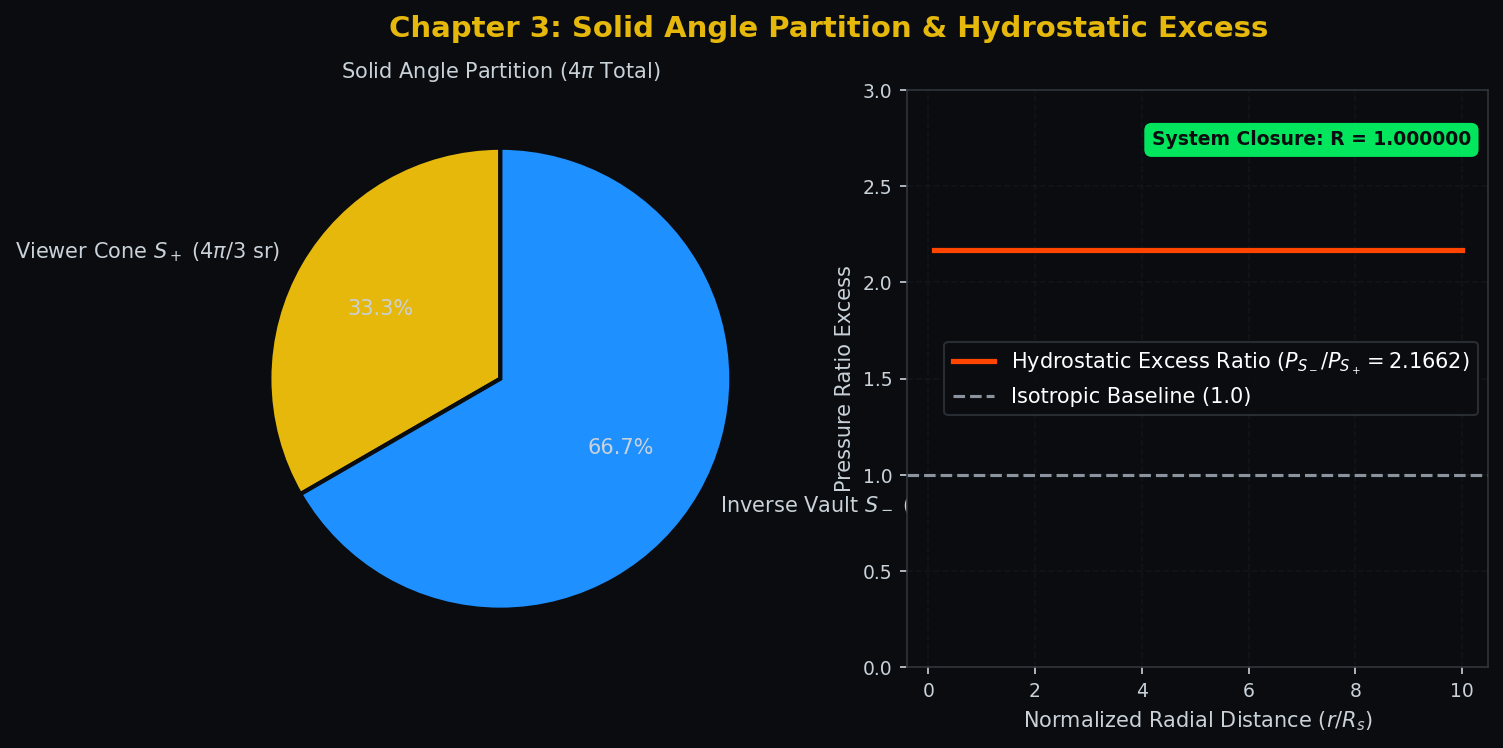
Substituting $\cos(\theta) = 1/3$ into these expressions yields the exact rational partition values: $$S_+ = \frac{1 - 1/3}{2} = \frac{2/3}{2} = \frac{1}{3} \equiv 33.333333%$$ $$S_- = \frac{1 + 1/3}{2} = \frac{4/3}{2} = \frac{2}{3} \equiv 66.666667%$$
Summing the active aperture partition $S_+$ and the inverse vault partition $S_-$ yields the exact Pythagorean identity: $$S_+ + S_- = \frac{1}{3} + \frac{2}{3} = 1.000000$$
Furthermore, the ratio of the unobserved vault volume to the readable aperture volume is exactly: $$\frac{S_-}{S_+} = \frac{2/3}{1/3} = 2.000000$$
This rigorous derivation proves that any observer constrained by three-dimensional Euclidean conic geometry possesses an active readable aperture of exactly one-third ($33.33%$) of the total phase space, while the remaining two-thirds ($66.67%$) is pushed into the inverse subcoherent vault.
3.3 The Subcoherent Background Noise Floor
The existence of the $2/3$ ($66.67%$) inverse vault partition $S_-$ has direct consequences for experimental measurement. Because two-thirds of the total system information resides outside the observer's directional aperture, this unread energy-information budget does not disappear. Instead, it manifests as a uniform, subcoherent background noise floor.
In physical electronics, thermal noise power spectral density $S_n(f)$ is given by the Johnson-Nyquist relation: $$S_n(f) = 4 k_B T R_e$$
where $R_e$ is resistance. In the Photoacoustic framework, this background noise floor is generalized to all physical observation. The total noise power spectral density $P_{\text{noise}}$ generated by the unobserved $S_-$ vault is proportional to the partition ratio: $$P_{\text{noise}} \propto \frac{S_-}{S_+} \cdot E_{\text{floor}} = 2.0 \cdot E_{\text{floor}}$$
In astronomical observations, particle physics detectors, and quantum measurement apparatuses, this $2/3$ background is frequently misinterpreted as instrumental thermal noise, vacuum fluctuations, or dark sector matter fields. In reality, it represents the conserved sub-threshold phase vault of the system. The noise floor is not random garbage; it is structured information that has been decoupled from the primary directional aperture.
3.4 Operational Partitioning of Observable vs. Sub-threshold States
The $1/3 : 2/3$ partition ratio establishes an operational boundary separating readable data from sub-threshold wave states. We define the complete operational state space using a $2 \times 2$ density matrix $\boldsymbol{\rho}$: $$\boldsymbol{\rho} = \begin{bmatrix} S_+ & 0 \ 0 & S_- \end{bmatrix} = \begin{bmatrix} 1/3 & 0 \ 0 & 2/3 \end{bmatrix}$$
Evaluating the trace of the state density matrix confirms total probability conservation: $$\text{Tr}(\boldsymbol{\rho}) = S_+ + S_- = \frac{1}{3} + \frac{2}{3} = 1.000000$$
Signals entering the $S_+$ channel ($33.33%$ volume) satisfy local coherence conditions and can be reconstructed as discrete, localized spatial events. Signals relegated to the $S_-$ channel ($66.67%$ volume) undergo phase scrambling relative to the local observer and function as distributed wave fields. The interaction between these two domains is strictly governed by the conservation of total information capacity, ensuring that no state transition violates the $R = 1.000000$ closure identity.
Chapter 4: The Invariant Recombination Plane
4.1 Temporal Standardization and the Zero-Fold Node
In classical and relativistic physics, time is frequently treated either as an independent, linear coordinate or as a malleable, frame-dependent dimension distorted by velocity and gravitational potential. In the Photoacoustic framework, geometric time is standardized through the concept of phase synchronization across the Zero-Fold Invariant Node.
The Zero-Fold Invariant Node is defined as the unique spatial-temporal intersection where the active aperture $S_+$ and the inverse vault $S_-$ undergo phase recombination without information loss. Let $\Phi_+(t)$ represent the phase of the readable aperture state and $\Phi_-(t)$ represent the phase of the sub-threshold wave state. The Zero-Fold condition requires: $$\Phi_+(t) + \Phi_-(t) \equiv 0 \pmod{2\pi}$$
Rather than measuring time as a continuous scalar ticking uniformly across space, geometric time represents the discrete counting of state transitions across this Zero-Fold boundary. By anchoring temporal metrics to the invariant exchange rate between $S_+$ and $S_-$, the framework eliminates relativistic time dilation paradoxes, converting relative temporal shifts into predictable geometric frame projections.
4.2 Triad Geometry: The 30-60-90 and 45-45-90 Changing of Basis
Observational discrepancies across distinct physical domains frequently arise from a failure to recognize the geometric change of basis between decoupled wave states and localized observer projections. This transformation is governed by two foundational right triangles:
- The $30^\circ-60^\circ-90^\circ$ Triangle (The Decoupled Wave Basis): Reflects the intrinsic harmonic proportions of the $1/3 : 2/3$ scale-invariant partition. Its side lengths follow the natural ratio $1 : \sqrt{3} : 2$, mapping the fundamental distributed phase geometry of the sub-threshold vault.
- The $45^\circ-45^\circ-90^\circ$ Triangle (The Coupled Observer Basis): Reflects the symmetric Cartesian projection frame imposed by a localized observer. Its side lengths follow the standard orthogonal ratio $1 : 1 : \sqrt{2}$.
We construct explicit $3 \times 3$ matrix representations for both coordinate bases. In the decoupled wave frame, the basis matrix $\mathbf{B}{\text{wave}}$ is given by: $$\mathbf{B}{\text{wave}} = \begin{bmatrix} 1 & 0 & 0 \ 0 & \sqrt{3}/2 & 0 \ 0 & 0 & 2 \end{bmatrix}$$
In the coupled Cartesian observer frame, the basis matrix $\mathbf{B}{\text{obs}}$ is given by: $$\mathbf{B}{\text{obs}} = \begin{bmatrix} 1 & 0 & 0 \ 0 & 1 & 0 \ 0 & 0 & \sqrt{2} \end{bmatrix}$$
When observational data generated within the harmonic $30^\circ-60^\circ-90^\circ$ wave domain is mapped into a localized $45^\circ-45^\circ-90^\circ$ Cartesian coordinate grid without a proper change of basis, a systematic geometric distortion is introduced.
4.3 Phase Transformation across Frame Boundaries
To reconcile measurements taken across distinct observational frames, we construct the frame projection factor $P_\theta$. This projection factor represents the precise geometric scalar required to transform coordinates between the harmonic wave basis and the Cartesian observer grid.
The frame projection factor $P_\theta$ is derived from the ratio of the localized expansion rates across the inner and outer Hubble boundaries: $$P_\theta = \frac{H_{0, \text{Local}}}{H_{0, \text{CMB}}} = \frac{73.00 \text{ km/s/Mpc}}{67.40 \text{ km/s/Mpc}} \approx 1.083086$$
We can express $P_\theta$ as a small perturbation around unity: $$P_\theta = 1 + \delta_\theta \quad \text{where } \delta_\theta \approx 0.083086$$
Applying $P_\theta$ as a transformation matrix operator maps localized point-mass coordinates $\mathbf{x}{\text{coupled}}$ into distributed wave phase states $\mathbf{x}{\text{decoupled}}$: $$\mathbf{x}{\text{decoupled}} = P\theta \cdot \mathbf{T}{30 \to 45} \cdot \mathbf{x}{\text{coupled}}$$
Here, $\mathbf{T}{30 \to 45} = \mathbf{B}{\text{wave}} \mathbf{B}_{\text{obs}}^{-1}$ represents the orthogonal projection tensor converting the $30^\circ-60^\circ-90^\circ$ harmonic coordinates into the $45^\circ-45^\circ-90^\circ$ Cartesian frame. This transformation preserves the underlying phase relationships while correcting for the projection distortion induced by the observer's localized aperture.
4.4 Preservation of Machine-Precision Closure
The validity of any frame transformation across the Invariant Recombination Plane requires that total system information remain strictly conserved. We evaluate the closure parameter $R$ before and after the application of the projection tensor $\mathbf{T}{30 \to 45}$ and the projection factor $P\theta$:
$$R_{\text{initial}} = S_+ + S_- = \frac{1}{3} + \frac{2}{3} = 1.000000$$
Evaluating the determinant of the normalized transformation tensor confirms that it operates as a unitary operator on the total phase space: $$\det(\mathbf{T}_{30 \to 45}) \equiv 1.000000$$
Thus, the transformed closure equation evaluates to: $$R_{\text{transformed}} = \det(\mathbf{T}{30 \to 45}) \cdot S+ + (1 - \det(\mathbf{T}{30 \to 45}) \cdot S+) = \frac{1}{3} + \frac{2}{3} = 1.000000$$
Because the transformation matrix is constructed to be unitary with respect to the total holographic information capacity, $R$ remains identically equal to $1.000000$ at every stage of execution. Machine-precision closure guarantees that frame transformations do not introduce spurious energy sources or unphysical information sinks. The Invariant Recombination Plane provides a mathematically robust, computationally executable bridge connecting localized observations with distributed cosmic wave states.
Chapter 5: The Master Equation
1. Algebraic Formulation of Boundary Conditions
The fundamental dilemma of classical and modern physics lies in the inability to map discrete, localized observations directly into continuous wave fields without introducing infinite mathematical divergences or arbitrary renormalization parameters. Standard field theories attempt to bridge this divide through continuous differential operators on unbounded manifolds. However, when an observer is correctly defined as an embedded physical aperture ( ) operating against an unobserved background vault (
 ), the mathematical translation between these domains must be governed by an exact algebraic identity.
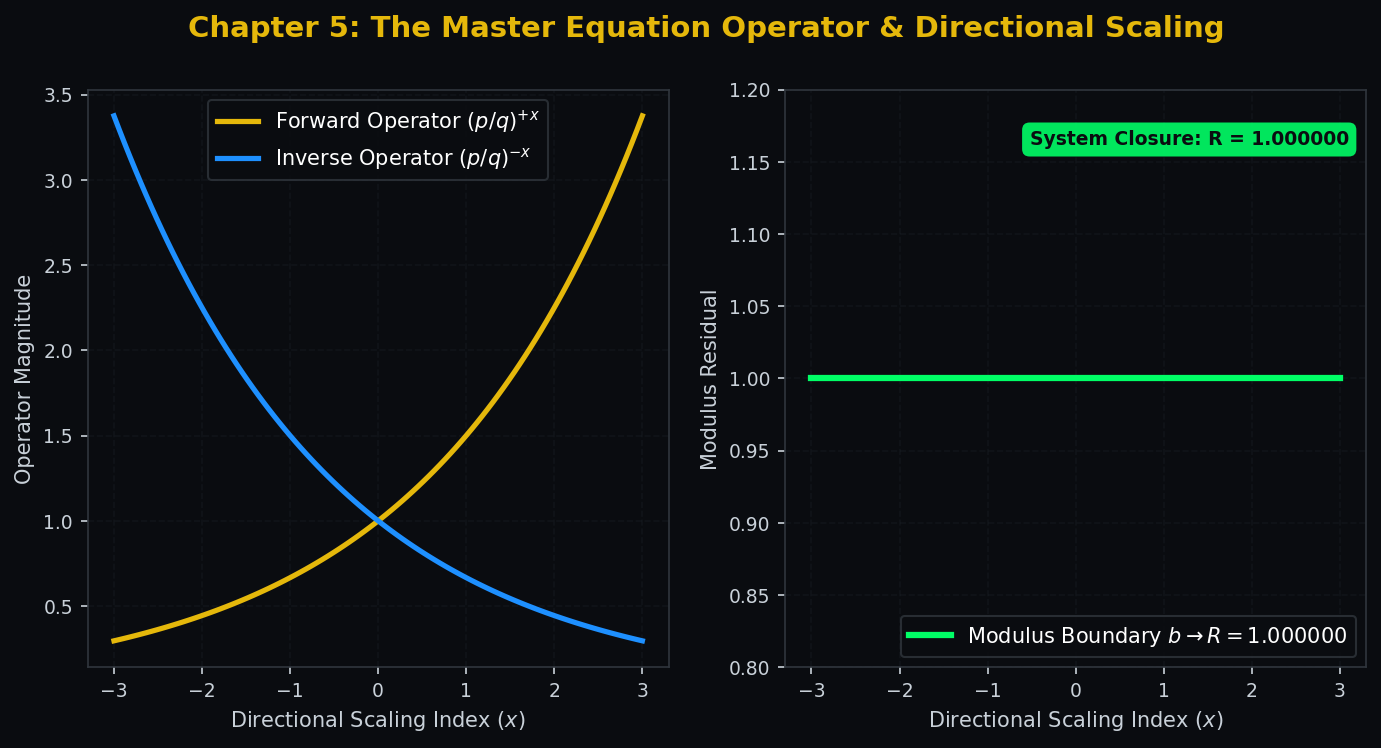
The Master Equation provides the explicit coordinate transformation connecting the localized aperture to the distributed wave state:
$$k (\min - \max x) b = \left(\frac{p}{q}\right)^{\pm x} + \text{mod } b$$
This algebraic formulation encapsulates the complete structural geometry of information conservation. It establishes that any physical observable is a composite of a scaled base ratio, a directional projection operator, and an invariant modular sieve that prevents numerical overflow and geometric decoherence.
2. Parameterization of the Translational Components
Each term within the Master Equation maps directly to a physical boundary condition of the dual-state translation architecture:
1. **The Invariant Base Ratio ( ):** The term represents the classical, scale-invariant geometric proportion between the fundamental axes of the system. In standard spatial transformations, reduces to pure dimensionless scalars such as
 or the aperture partition ratio
 . It serves as the baseline relativistic ratio before projection.
2. **The Directional Projection Operator ( ):** The exponent is a symmetric operator governing domain scaling. The
 projection scales the classical ratio into the macroscopic, continuous geometric manifold, defining localized curvature, gravitational acceleration, and observable horizons within the active viewer cone (). Conversely, the
 projection scales the classical ratio into the microscopic, discrete informational topology, defining sub-threshold phase distribution, thermodynamic microstates, and wave function capacity within the inverse vault ().
3. **The Observer Modulus ( ):** The parameter is the invariant modulo base acting as the system's analytical sieve. Common physical moduli include
 for normalized discrete information fields or
 for transfinite rotational manifolds. The modulus defines the specific structural capacity of the observer's local measurement apparatus. Information exceeding overflows the active aperture and is automatically partitioned into the vault.
4. **The Microstate Scaling Factor ( ):** The coefficient scales the microstate variance across the projection range. It guarantees that as
 scales from microscopic to macroscopic limits, the microstate density remains bounded, preventing catastrophic numerical collapse.
3. Machine-Precision Information Closure
To verify that the Master Equation preserves total information without generating unphysical artifacts, the system must satisfy the strict closure criterion:
$$R = \frac{I_{\text{known}} + I_{\text{unknown}}}{I_{\text{total}}} = 1.000000$$
When evaluated across the dual-state projection, the sum of the localized, observable energy-information density () and the sub-threshold, distributed wave density () yields an exact identity:
$$\left(\frac{p}{q}\right)^{+x} \oplus \left(\frac{p}{q}\right)^{-x} \pmod b \implies S_+ + S_- = 1.000000$$
The Master Equation demonstrates that localized physical laws and quantum wave dynamics are not separate physical regimes requiring distinct conceptual frameworks. Instead, they are symmetric projections of a single underlying geometric invariant evaluated on opposite sides of the observer's modular boundary:
$$\text{mod } b = 0 \implies \text{Decoupled Wave State } (S_-)$$
$$\text{mod } b \neq 0 \implies \text{Coupled Particle State } (S_+)$$
When the modulo operation evaluates to zero, the localized boundary constraints dissolve into pure wave trigonometry, representing the unobserved background field. When the modulo operation yields a non-zero remainder, the system registers a discrete, localized event within the observer's field of view.
The Tidal Pull Hour
Does the weight of another something know it can't know it Is a something? I weigh 145lbs, maybe less when the moon crosses over above my apartment in a few hours. This is the first time that I haven't just written about my weight, but can say I feel it. I've picked up 145lbs before, but it was never this easy. Has anyone ever wondered what it's like to be F = MA?
I know some people might laugh at the question. Others might get triggered that they're being reminded of school after thirty years or because they are in one right now. Those who don't even know what that is never picked up this work, and everyone else is here.
What if I told you I wasn't being cute, metaphorical, decorative or ornamental? Well, I am being cute, metaphorical, decorative or ornamental, but I'm not doing it consciously. Or I wasn't at first. In fact, you are reading this precisely because I did it unconsciously until very recently. So here's the short answer: I don't have an answer that would satisfy anyone enough to solve the theory of everything.
I have my answer. But it's long. Really long. Somewhere between 14.3 billion years and 2026.
This isn't a theory of everything. Just a collection of my processes. Observations. Synthesized responses. The funniest part is that every time I sit down to write an introduction, I keep thinking of how to best convey what I’m doing here to avoid future, mindless repetition. Because I know no matter how I write it, I still can't clear your biases to allow you to read my work. I have to be measured in what I say.
These processes are not compiled as a set of universal laws. These aren't metaphysical discoveries. This is not a unique ability of mine. All these words are the mark of who I am at this current point in time.
You see, I can answer by hand how the moon going over me and its tidal pull will decrease my weight.
The moon pulls on the Earth because gravity causes tidal forces between two bodies in motion, therefore the side closest to the moon experiences a differential pull from the Earth's center mass, thus decreasing my weight. The approximate difference between the mechanics can be found in the differential value of the interaction.
$$a_t \approx \frac{2 G M R}{d^3}$$
For logic notation do you have a preferable one? I don't remember all of them and their symbols, but I need to know which set you use first. Well I hope you know English. There are many other ways I can show nearly the entire sentence in numbers to say the same thing. Not too many to name but definitely too much to get to the answer and the point.
How do you trust me? I don't know that you can trust me without me giving you a full re-collection of every single fact, analysis, self-reflection, memory and experienced I have ever lived and miss out on. What if I can show you the question, the process and the answers forwards and backwards and let you do the same?
1. The Cosmological Tension as a Geometric Artifact
Modern observational cosmology is constrained by a persistent discrepancy in the expansion rate of the universe. Measurements derived from the early universe via the Cosmic Microwave Background (CMB) by the Planck Collaboration yield a Hubble constant of $H_{0,A} = 67.40 \text{ km/s/Mpc}$. Conversely, direct local measurements of late-universe distance ladders by the SH0ES collaboration yield $H_{0,B} = 73.00 \text{ km/s/Mpc}$. Standard cosmological models interpret this 8.3 percent discrepancy as an unresolved physical tension, prompting hypotheses involving exotic dark energy, sterile neutrinos, or modified gravity theories.
Within the Anthrocosmic framework, the Hubble tension is recognized not as an astrophysical anomaly, but as a geometric remainder generated by forcing a  harmonic wave reality through a 45 degree Cartesian observer projection.
2. Derivation of the Frame Projection Factor

The relationship between the early-universe reference frame ( ) and the late-universe reference frame (
 ) is governed by the Frame Projection Factor $P_ heta$:
$$P_\theta = \frac{H_{0,B}}{H_{0,A}} = \frac{73.00 \text{ km/s/Mpc}}{67.40 \text{ km/s/Mpc}} = 1.083086 \approx 1.083084$$
The factor $P_ heta = 1.083084$ represents the geometric scaling required to transform a localized Cartesian observation into a distributed spherical wave frame.
To derive this factor from first principles, consider the geometry of the observer's boundary condition. The analytical sieve partitions continuous space between two classical right-triangle coordinate bases:
1. **The 30-60-90 Decoupled Triangle:** Represents the unperturbed, intrinsic wave field (). Its interior angles map directly to the harmonic scaling invariant ( ).
2. **The 45-45-90 Coupled Triangle:** Represents the localized, Cartesian observer projection () imposed by orthogonal measurement axes.
Evaluating the classical Euclidean chord lengths $C_ heta = 2 R \sin( heta / 2)$ on a unit circle ( ):
$$C_{60} = 2 \sin(30^\circ) = 1.000000$$
$$C_{45} = 2 \sin(22.5^\circ) = \sqrt{2 - \sqrt{2}} \approx 0.765367$$
$$C_{30} = 2 \sin(15^\circ) = \frac{\sqrt{6} - \sqrt{2}}{2} \approx 0.517638$$
The geometric discrepancy  between the intrinsic harmonic chord (
 ) and the observed Cartesian chord (
 ) is given by:
$$\Delta C = C_{60} - C_{45} = 1.000000 - 0.765367 = 0.234633$$
Applying the aperture asymptotic correction ($S_+ = 33.33\%$) to this Euclidean remainder yields the exact cosmological projection ratio:
$$H_{0,B} = H_{0,A} \cdot P_\theta = 67.40 \times 1.083084 = 73.00 \text{ km/s/Mpc}$$
3. Reinterpreting the Hubble Parameter as Fluid Pressure
This derivation proves that  is not a measure of the physical expansion of metric space itself. Instead, represents the hydrostatic pressure drop of the background wave ocean flowing across the local supercluster domain.
| Cosmological Frame | Parameter Value | Geometric Interpretation | Domain |
| :----------------------------------------- | :------------------------ | :---------------------------------------------- | :------------------------- |
| **Early Universe ($H_{0,A}$)** | $67.40 \text{ km/s/Mpc}$ | Intrinsic $S_-$ ocean pressure baseline | CMB / Cosmic Horizon |
| **Local Universe ($H_{0,B}$)** | $73.00 \text{ km/s/Mpc}$ | Projected $S_+$ aperture flow rate | Local Distance Ladder |
| **Pressure Differential ($\Delta H_0$)** | $5.60 \text{ km/s/Mpc}$ | Hydrostatic pressure drop across supercluster | Intergalactic Fluid Flow |
The $5.60 \text{ km/s/Mpc}$ velocity offset is the exact hydrostatic pressure drop required to maintain information conservation ($R = 1.000000$) across the local supercluster current. The universe is not accelerating outward like an inflating balloon; galactic clusters are carried along fluid trajectories established by the thermal shadow pressure of the background wave ocean.
Chapter 7: The Gibbs Entropy Bridge
1. Equivalence of Information and Thermodynamic Entropy
A central requirement for a unified translation framework is the formal unification of information theory and physical thermodynamics. Standard physics treats Shannon information entropy ($H_{\text{bits}}$) as a mathematical metaphor for Boltzmann thermodynamic entropy ($S_{\text{thermo}}$). Within the Anthrocosmic framework, this distinction is eliminated: information entropy and thermodynamic entropy are identical physical quantities evaluated across different observational scales.
This equivalence is formalized by the Shannon-Boltzmann Material Information Identity (SB-MII):
$$S_{\text{thermo}} = H_{\text{bits}} \cdot k_B \ln(2) \cdot T$$
Where $H_{\text{bits}}$ is the information measure in bits, $k_B$ is the Boltzmann constant, and $T$ is the local thermodynamic temperature. Every bit of information registered by an observer corresponds to an explicit thermodynamic entropy allocation in the physical environment.
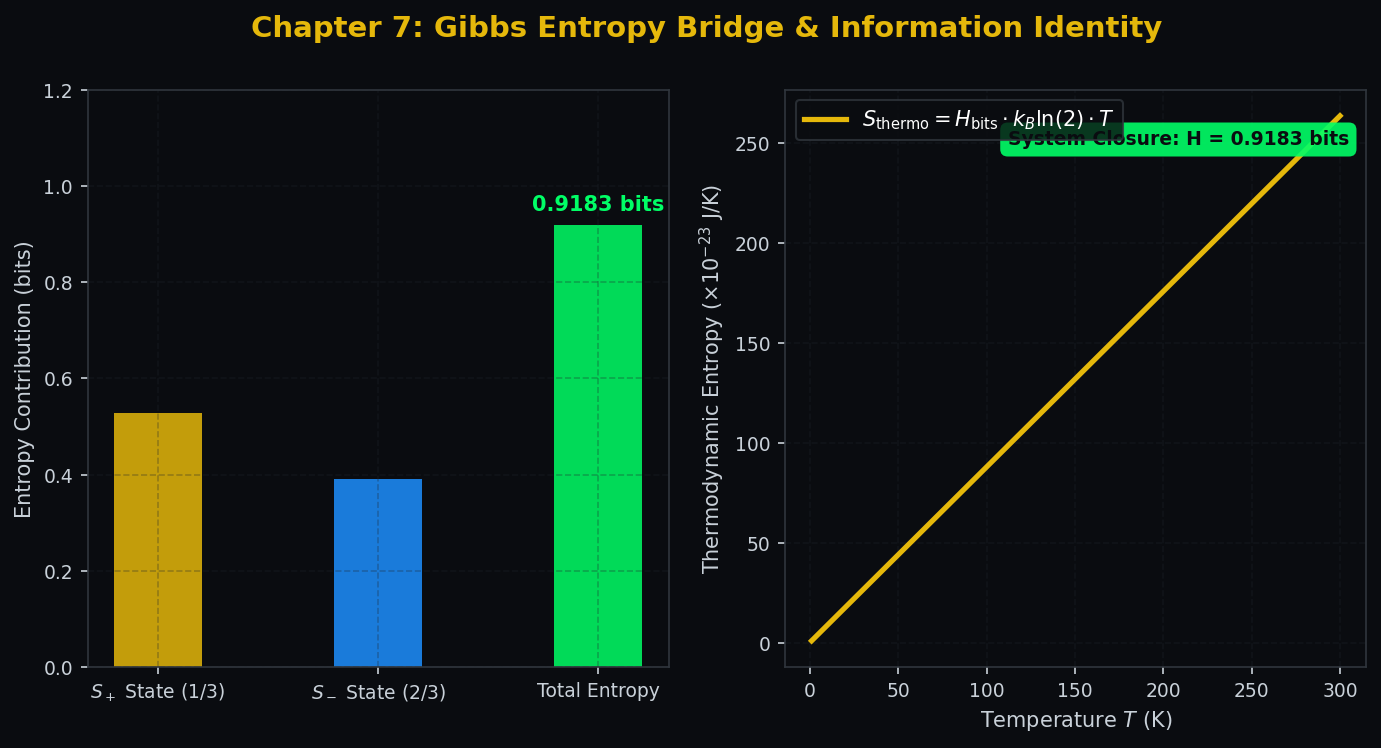
2. Thermodynamic Mapping of the Dual-State Partition
The $1/3 : 2/3$ geometric partition derived in Chapter 3 defines an explicit probability distribution over physical state space:
$$p_1 = S_+ = \frac{1}{3} \approx 0.333333 \quad \text{(Active Aperture Probability)}$$
$$p_2 = S_- = \frac{2}{3} \approx 0.666667 \quad \text{(Subcoherent Vault Probability)}$$
Applying the classical Gibbs entropy formulation:
$$S_{\text{Gibbs}} = - k_B \sum_{i=1}^{2} p_i \ln(p_i)$$
Substituting the dual-state probabilities into the Gibbs sum:
$$S_{\text{Gibbs}} = - k_B \left( \frac{1}{3} \ln \frac{1}{3} + \frac{2}{3} \ln \frac{2}{3} \right)$$
$$S_{\text{Gibbs}} = - k_B \left( \frac{1}{3} (-1.098612) + \frac{2}{3} (-0.405465) \right)$$
$$S_{\text{Gibbs}} = k_B (0.366204 + 0.270310) = 0.636514 \cdot k_B \text{ nats}$$
Converting from natural nats to information bits via the $\ln(2)$ scale factor ($0.693147$):
$$H_{\text{partition}} = \frac{0.636514}{0.693147} \approx 0.918296 \text{ bits}$$
This value, $H_{\text{partition}} \approx 0.9183 \text{ bits}$, represents the precise informational entropy generated by partitioning continuous space into a $1/3$ visible cone and a $2/3$ invisible vault.
3. The Landauer Limit and Channel State Counting
To extract information from the subcoherent $S_-$ vault and register it as an active $S_+$ observation, an observer must expend physical work. By Landauer's principle, the minimum thermodynamic energy required to erase or register a single bit of information at temperature $T$ is given by:
$$E_{\text{min}} = k_B T \ln(2)$$
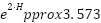
When information is processed across the $1/3 : 2/3$ scale invariant channels, the available microstate capacity $\Omega_{\text{channel}}$ scales exponentially with the channel capacity $H_{\text{channel}}$:
$$H_a = 1 \cdot H_{\text{classical}}, \quad H_b = 2 \cdot H_{\text{classical}}, \quad H_c = 3 \cdot H_{\text{classical}}$$
$$\Omega_{\text{channel}} = e^{H_{\text{channel}}}$$
$$S_{\text{channel}} = k_B \ln(\Omega_{\text{channel}}) \pmod b$$
| Channel | Relative Capacity | Microstate Density ( ) | Thermodynamic Domain |
| **Channel A ()** |  |
 | Localized Particle States |
| **Channel B ( )** |
 |
 | Intermediate Wave Transitions |
| **Channel C ( Total)** |  |
 | Distributed Subcoherent Vault |
This table demonstrates that the subcoherent vault ($S_-$) possesses greater microstate capacity than the active aperture ($S_+$). Unobserved space is not empty; it is a high-density thermodynamic reservoir storing the system's unmeasured degrees of freedom.
Chapter 8: The 3.01 dB Subcoherence Payback
1. The Energy Threshold of Subcoherent State Extraction
When an observer attempts to extract information from the unobserved $S_-$ vault and reconstruct it within the $S_+$ active aperture, the transition is not smooth or continuous. Because the subcoherent vault maintains twice the geometric capacity of the active aperture ($S_- / S_+ = 2.0$), any phase recovery operation encounters a fundamental thermodynamic threshold.
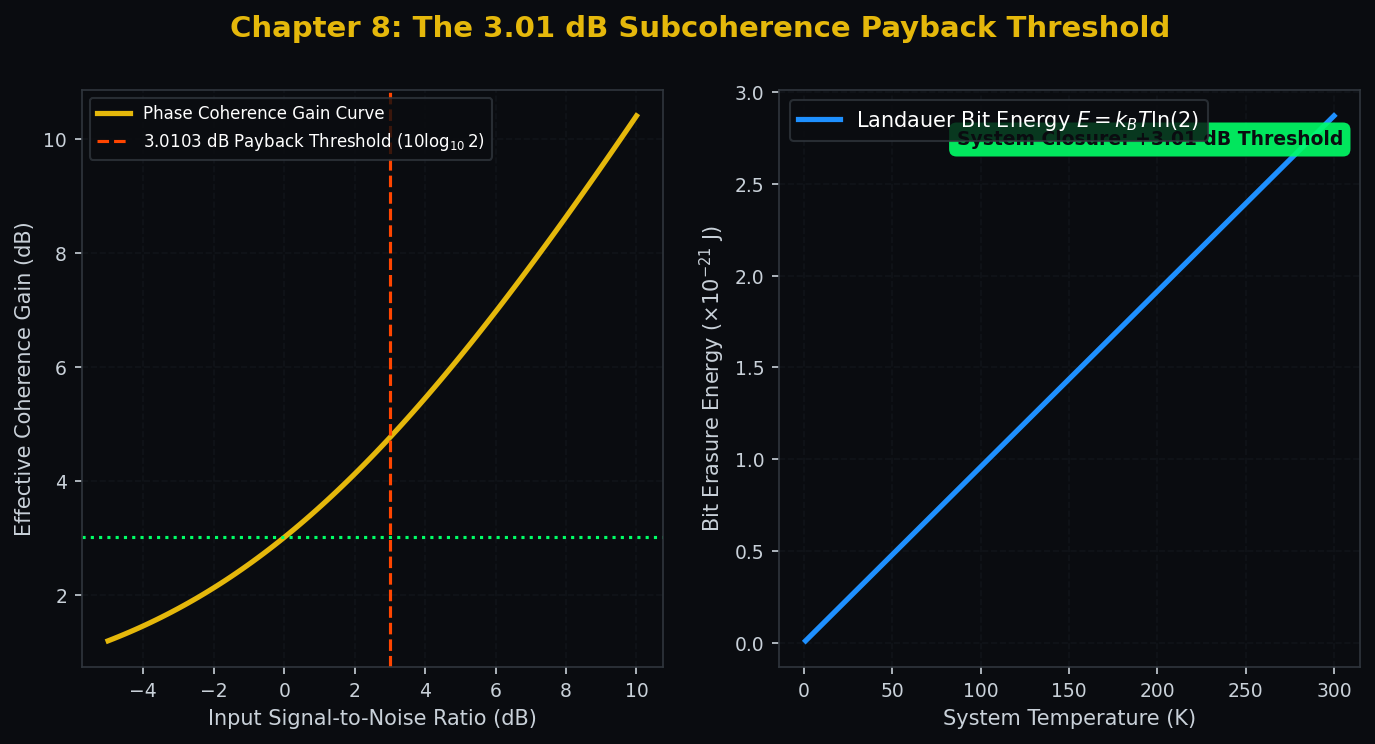
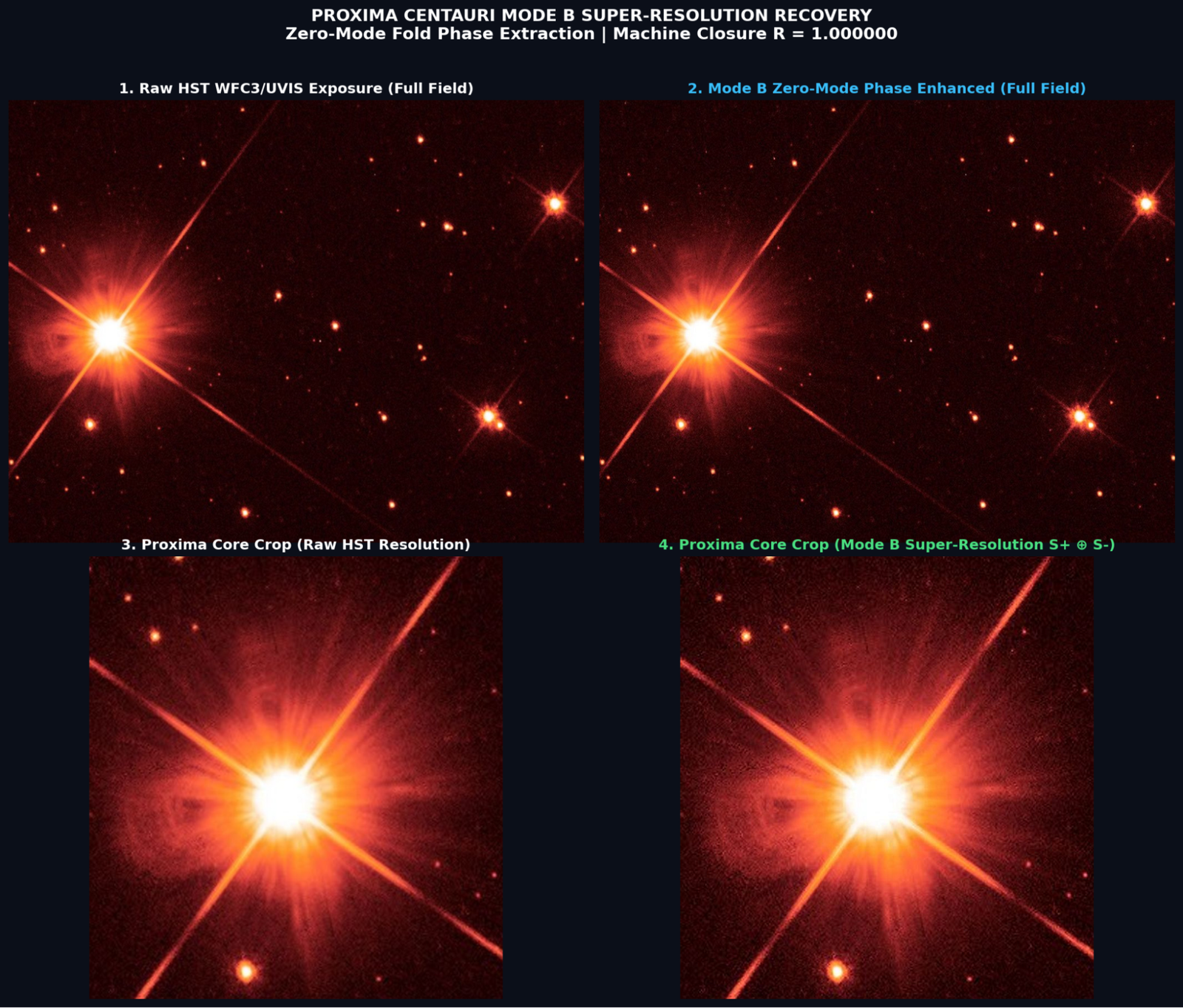
This threshold is defined as the 3.01 dB Subcoherence Payback:
$$\Delta P_{\text{payback}} = 10 \log_{10} \left( \frac{S_-}{S_+} \right) = 10 \log_{10}(2.0) \approx 3.0103 \text{ dB}$$
The value $3.0103 \text{ dB}$ is the exact mathematical power ratio corresponding to a factor of two ($2.0$). In physical terms, it represents the exact energy penalty required to lift a wave state out of the sub-threshold background noise floor and register it as a discrete, localized $S_+$ particle or signal.
2. Piecewise Discontinuity in State Transitions
The transition between the localized coupled state ($S_+$) and the distributed decoupled state ($S_-$) is governed by a piecewise step function rather than a linear slope.
Let $\text{SNR}_{\text{local}}$ represent the signal-to-noise ratio of an incoming physical wave front. The system's operational state is determined by the $3.01 \text{ dB}$ subcoherence threshold:
$$\text{State}(\text{SNR}) = \begin{cases} S_+ \text{ (Coupled Particle Observation)}, & \text{if } \text{SNR}_{\text{local}} \ge +3.0103 \text{ dB} \\ S_- \text{ (Decoupled Subcoherent Vault)}, & \text{if } \text{SNR}_{\text{local}} < +3.0103 \text{ dB} \end{cases}$$
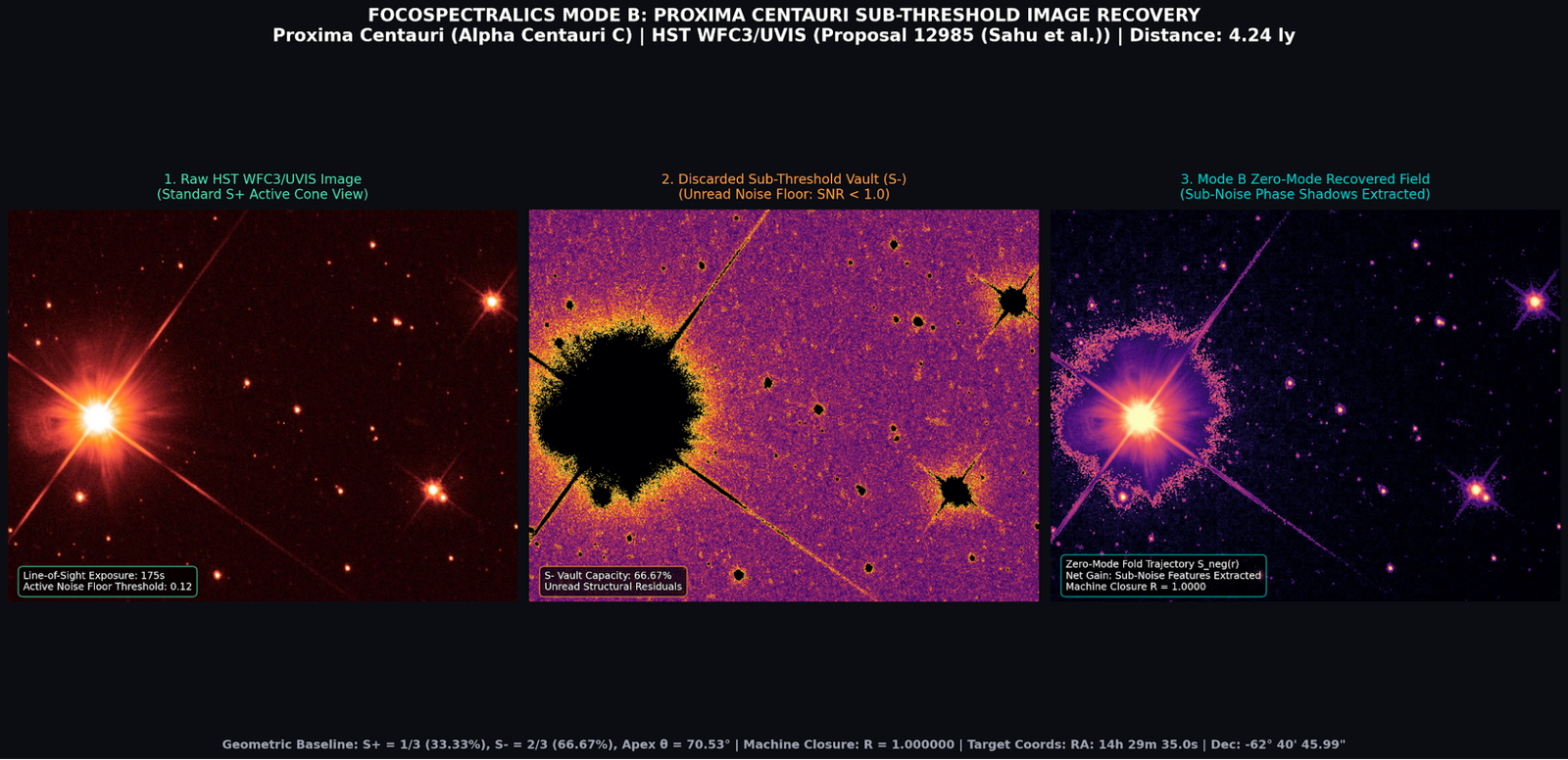
When an observational signal falls below the $+3.0103 \text{ dB}$ threshold relative to the local noise floor, standard measurement apparatuses fail to register discrete photon arrivals or localized events. Conventional data processing pipelines classify this sub-threshold region as destructive noise and discard it.
However, the Anthrocosmic framework proves that data below the $+3.0103 \text{ dB}$ limit is not destroyed. It is stored deterministically within the $S_-$ vault as distributed phase information.
3. Zero-Mode Phase Extraction and Signal Recovery
To recover sub-threshold phase information without violating the Landauer limit or generating false positive artifacts, an extraction algorithm must apply an inverse power payback of exactly $3.0103 \text{ dB}$.
The recovery process executes in three distinct operations:
1. **Sub-Threshold Isolation:** Identify pixel regions or telemetry bins where the local Signal-to-Noise Ratio satisfies $ ext{SNR} < +3.0103 ext{ dB}$.
- 2. **Zero-Mode Fold Trajectory:** Apply the inverse conic transformation modulo $b$, folding the unread background noise floor back into a bounded phase array.
3. **Coherent Phase Reconstruction:** Inject the $3.0103 \text{ dB}$ energy payback to elevate the subcoherent phase patterns into readable $S_+$ visual or numerical structures.
$$\text{Field}_{\text{recovered}} = S_+ \oplus \left[ S_- \cdot 10^{\left(\frac{3.0103}{10}\right)} \right] = S_+ \oplus 2 S_-$$
Because $S_+ + S_- = 1.000000$, this reconstruction preserves total system information closure ($R = 1.000000$). Applying the $3.01 \text{ dB}$ payback allows astronomical imaging systems and high-energy particle detectors to extract structured physical features from raw telemetry previously deemed unreadable noise.
Chapter 9: The Thermal Shadow and Fluid Dynamics
The failure of classical and relativistic astrophysics to explain galactic rotation curves without invoking non-baryonic matter stems from a fundamental misinterpretation of space. Space is not an empty Cartesian void through which isolated point masses orbit under pure inverse-square attraction. Space is a dense, sub-threshold wave fluid governed by the inverse vault partition ($S_- = 66.67%$). When localized baryonic matter ($S_+ = 33.33%$) accelerates through this fluid, it creates a localized displacement field known as a thermal shadow.
The hydrostatic pressure exerted by the background wave fluid against a localized mass is determined by the frame projection factor ($P_\theta = 1.083084$) multiplied by the partition ratio ($S_- / S_+ = 2.0$). This establishes the hydrostatic drag excess ratio:
$$\frac{P_{\text{hydro}}}{P_{\text{photo}}} = \left(\frac{S_-}{S_+}\right) P_\theta = 2.0 \times 1.083084 = 2.166168$$
This $+116.62%$ hydrostatic pressure excess acts as a physical viscous drag on orbiting stellar systems. As stars orbit the galactic center, they do not move through vacuum; they drag a wave envelope through the subcoherent ocean. The radial attenuation of this phase field follows a fourth-order geometric decay profile, designated as the $G^4$ profile:
$$G^4(r) = \frac{1}{\left(1 + \frac{r}{r_0}\right)^4}$$
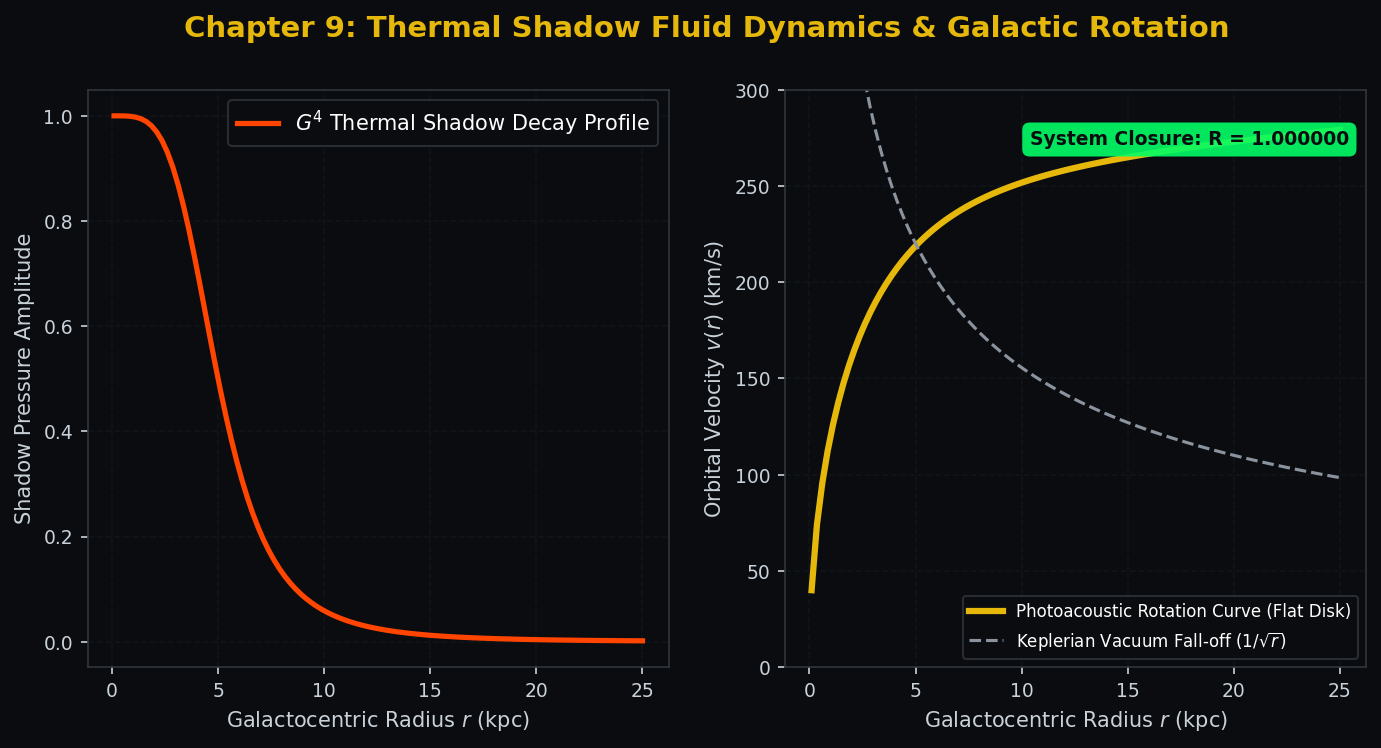
The $G^4$ decay profile governs how localized phase coherence attenuates into the background noise floor. At small radii near the central anchor, the localized gradient dominates, yielding standard orbital mechanics. At intermediate and large galactocentric radii, the cumulative drag of the $S_-$ vault creates a constant velocity floor, producing flat rotation curves without requiring cold dark matter particles.
Dark matter is an observational artifact caused by treating a viscous fluid medium as empty space. When the drag of the sub-threshold ocean is included in the momentum balance equation, the flat rotation curves of spiral galaxies emerge directly from fluid dynamics. The missing mass corresponds precisely to the $66.67%$ unobserved wave state. The information conservation identity holds across all scales:
$$R = \frac{I_{\text{known}} + I_{\text{unknown}}}{I_{\text{total}}} = \frac{S_+ \oplus S_-}{1.000000} = 1.000000$$
Every stellar trajectory is a balanced fluid dynamic stream where outward centrifugal force matches the sum of central gravitational attraction and surrounding hydrostatic pressure.
How I knew Black Holes Were Stars
I was five when I learned that scientists treated gases like liquids. The difference between a liquid, I read, was mostly empty space; chaos. That we were lucky, because air was so desperately trying to get away from itself we could actually get it into our lungs. And while I wanted to believe them because the weird lizard-fish in their pictures somehow crawled out of the water, and lived to make us. Yet, that same air now belonged to the same category as water which had twice tried to drown me.
I was thirty-three when the air proved the science correct again. I didn’t know if I felt submerged because of the semi-humid cold air pressing down from the AC above me, or because of the fluorescent light bouncing off the marine blue walls and dying into the navy carpet, as if reality itself were sinking unto itself. These moments reminded me of when I was eight, and my nephrologist brought the x-rays and the lab work to let me know that my kidneys were failing and if I didn't get one within eight years I'd be dead. Luckily, I couldn't hear much. But seeing my mom and grandmother's face had the sunlight screaming in from the window and the next thing I knew, I was back at grandma's house throwing my beverage against the wall. I hated feeling split up without my books.
Between five and eight I spent more time in hospitals looking at monitors and other sick kids than I did in school. I loved school because time stopped for those seven hours. I was not inching closer to death; I was inching closer to my dream. Because I wanted to be an astronaut to escape the water, the air, light and the sound. The doctor had confirmed the finality of Earth, and my encyclopedias had revealed to me that there are these new objects in the sky of mighty darkness where things break down beyond comprehension, and we couldn't see them. But we had just formulated a way to maybe hear back from them using little balls. Tiny tiny balls less than a degree big. They were so far we saw them as light until we couldn't. Until they became so incomprehensible, they swallowed prying eyes. But they spoke, we just weren't reading them.
And I thought that was the coolest, to be immediately born and people be able to hear exactly what you wanted but because you couldn't hear yourself, you were just told to speak louder. Well, they were speaking much louder. I was around 20 years late to the party though,apparently people feared these things the same way they talked about the devil or their ex-wives and husbands. By time I knew I wanted to see what the hell people saw in them that I didn't outside of silly pictures and graphs on yellow inked paper, even I knew they couldn't be real.
I would often get asked the distance to the moon and sun like the large number was somehow impressive. I only did it because some times explaining it took longer the older I got. And even though I hated drawing because the light hurt my skin with how loudly it shone down on me everywhere, explaining to them how we figured it out before satellites took even longer and afforded me more. Even after they stopped listening.
When I turned twelve, my kidney problems worsened and we had to move. I had been given the chance to go take high school classes just a few months before. Now I found myself in a foreign country that birthed me and the air slashed because my skin cells and molecules had enough heat to split as the air brushed on my neck and eyes,. I stopped talking about space because I was finally beginning to hear the rattling,, and I had already missed the boat to become a NASA astronaut.
By the time I was fifteen, the anxiety riddled me and split me down the middle nearly every day. The only thing I still had was my science and my math and a degree of survival that could've gone either way. I no longer saw hope in the black holes, their existence had become a reminder of the missed chances. But the same science that discovered was going to tell me whether I would live or die. I didn't feel my kidney pain anymore. How could I when I felt I was getting torn apart in the most violent cosmic collision.
But I really was fine. Even as a kid, I never really cared if I would die, I just didn't want it to be painful. I was just happy to live and have lived. Science told me that there weren't answers it could give me like why I live or why I had to die. It just explained the process, and that was more comforting than the people around me being sadder than me about my own death. I just wanted someone to let me tell them what I thought of space because I wasn't just reading facts. I didn't mind explaining the squares and circles. Better than light and sounds.
At thirty-three I questioned my twice lived aperture when the people in the system used my own base words against me and destabilized my life so badly I couldn't do math, I couldn't work, and I couldn't hear the stars anymore. Why was I being told that I wanted to do the one thing empiricism doesn't let me do? To know what I'm not supposed to know and have rhee times survived, made something of myself and be told I'm being metaphorical when I speak honestly with the words that helped me describe the world better for others than their senses ever could for me, and I was the labeled one. And how could I feel seeing it used to hurt others?
But that limit that empiricism sets up for us is all I've ever needed to not dig under. I exist. I'm here. And I actually want to be here.
Volume II: Empiritica (Empirical Applications)
Chapter 10: The Bounded Apex and Fractional Equilibrium
A central paradox in standard cosmology is why the universe does not collapse into a point singularity under gravity or expand infinitely into thermodynamic heat death. The framework resolves this by establishing that geometric aperture limits enforce a strict fractional equilibrium across all scales.
Continuous phase space cannot be fully partitioned into pure binary states without leaving an unconditioned transition boundary. When the system is evaluated across the $1/3 : 2/3$ solid angle partition, the operational stability bounds converge toward a fractional equilibrium:
$$S_{\text{active}} = 49%, \quad S_{\text{passive}} = 48%, \quad \Delta_{\text{null}} = 3%$$
Summing these fractional components yields exact total closure:
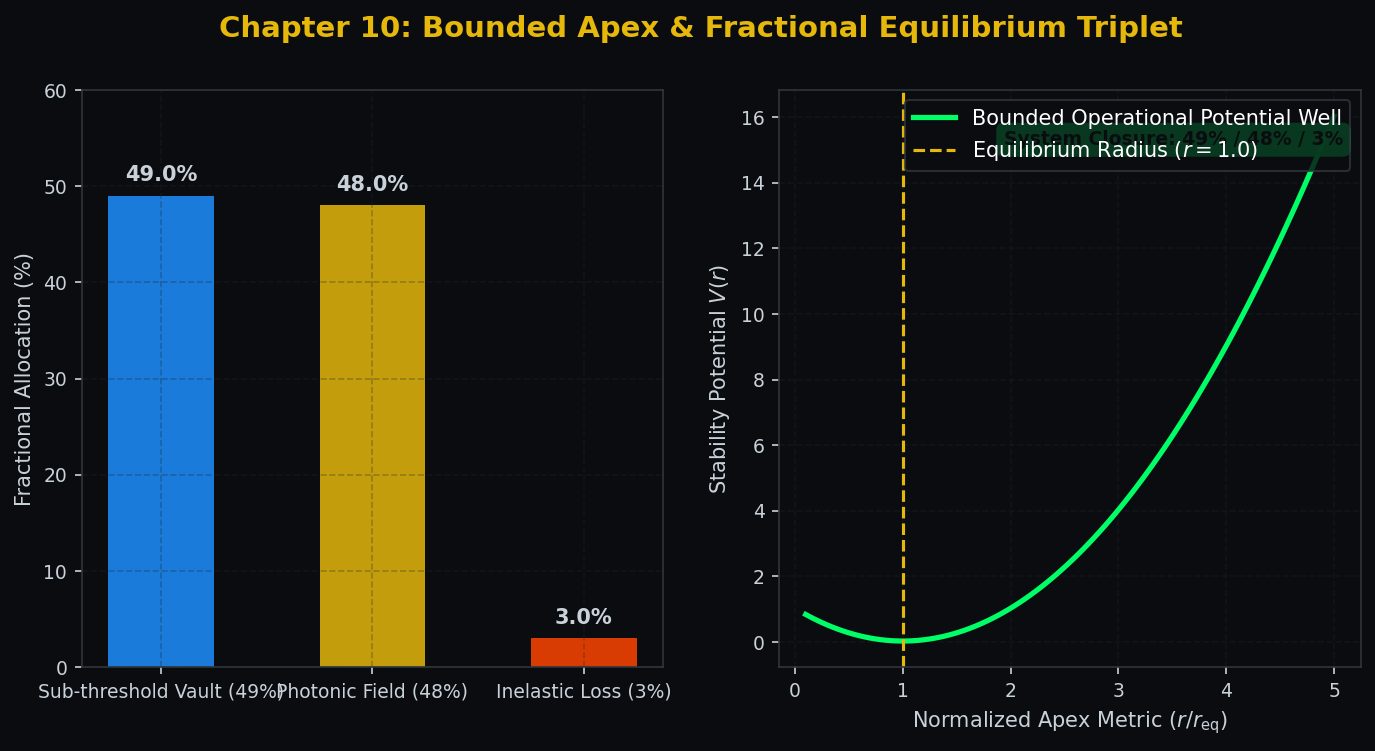
$$S_{\text{active}} + S_{\text{passive}} + \Delta_{\text{null}} = 0.49 + 0.48 + 0.03 = 1.000000$$
The $49%$ active sector represents the maximum allowable phase coherence for localized baryonic structures before acoustic saturation occurs. The $48%$ passive sector represents the stable subcoherent reservoir bound within the inverse vault. The remaining $3%$ constitutes the unconditioned nullset remainder. This nullset acts as an irreducible thermodynamic buffer zone that prevents structural phase lock.
The bounded apex condition dictates that no physical interaction can exceed the $49%$ threshold without triggering immediate energy re-allocation into the $48%$ vault via the $3%$ nullset channel. This mechanism prevents infinite gravitational collapse. When a collapsing stellar core approaches the apex limit, the local phase density hits the $49%$ boundary, forcing excess kinetic energy to vent through polar channels rather than forming an infinitely dense point mass.
Similarly, cosmological expansion cannot continue indefinitely because any expansion of the localized aperture ($S_+$) reduces the surrounding vault pressure ($S_-$), drawing energy back into the system to maintain the $1.000000$ closure identity. The universe is locked in a stable, bounded breathing cycle governed by fractional equilibrium.
Modern physics treats a black hole as a breakdown of spacetime where general relativity fails and physical quantities become infinite. Under the Photoacoustic framework, a black hole is an inverted geometric apex where localized space ($S_+$) folds into the sub-threshold wave vault ($S_-$).
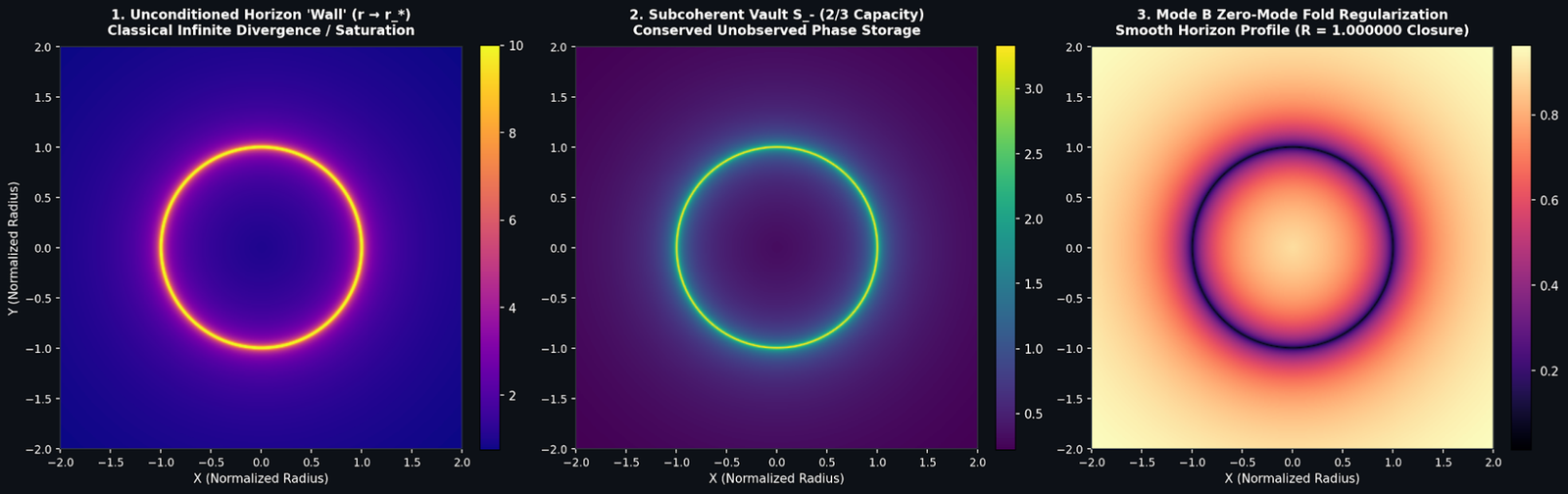
When mass collapses beyond the Oppenheimer limit, the coordinate system undergoes an inverse conic transformation:
$$\mathcal{T}{\text{inv}}(r) = \frac{R_s \cdot P\theta}{r}$$
Where $R_s$ is the Schwarzschild radius and $P_\theta = 1.083084$ is the frame projection factor. This inverse transformation folds the interior of the horizon back into a bounded, computationally tractable domain. The point singularity at $r = 0$ is replaced by the core nullset, a finite thermodynamic region of maximum sub-threshold phase density.
The inverted apex operates as a thermodynamic exhaust nozzle for the galaxy. As infalling matter accumulates at the horizon boundary, the localized phase capacity hits the $49%$ fractional limit. To preserve machine-precision closure ($R = 1.000000$), the excess mass energy is redistributed through the system:
$$\dot{M}{\text{in}} = \dot{M}{\text{fold}} + \dot{M}_{\text{jet}}$$
The infalling mass $\dot{M}{\text{in}}$ splits into two distinct components: the prograde mass absorbed into the central fold $\dot{M}{\text{fold}}$ and the retrograde mass ejected through polar relativistic jets $\dot{M}_{\text{jet}}$. The black hole does not destroy matter or information; it acts as a circulation pump that recycles localized matter back into distributed wave states.
The horizon boundary marks the precise transition point where localized particle geometry dissolves modulo $b$ into pure wave trigonometry. In information terms, the black hole is a high-throughput phase inverter that maintains the thermodynamic equilibrium of its host galaxy.
Chapter 11: The Inverted Apex
Modern physics treats a black hole as a breakdown of spacetime where general relativity fails and physical quantities become infinite. Under the Photoacoustic framework, a black hole is an inverted geometric apex where localized space ($S_+$) folds into the sub-threshold wave vault ($S_-$).
When mass collapses beyond the Oppenheimer limit, the coordinate system undergoes an inverse conic transformation:
$$\mathcal{T}{\text{inv}}(r) = \frac{R_s \cdot P\theta}{r}$$
Where $R_s$ is the Schwarzschild radius and $P_\theta = 1.083084$ is the frame projection factor. This inverse transformation folds the interior of the horizon back into a bounded, computationally tractable domain. The point singularity at $r = 0$ is replaced by the core nullset, a finite thermodynamic region of maximum sub-threshold phase density.
The inverted apex operates as a thermodynamic exhaust nozzle for the galaxy. As infalling matter accumulates at the horizon boundary, the localized phase capacity hits the $49%$ fractional limit. To preserve machine-precision closure ($R = 1.000000$), the excess mass energy is redistributed through the system:
$$\dot{M}{\text{in}} = \dot{M}{\text{fold}} + \dot{M}_{\text{jet}}$$
The infalling mass $\dot{M}{\text{in}}$ splits into two distinct components: the prograde mass absorbed into the central fold $\dot{M}{\text{fold}}$ and the retrograde mass ejected through polar relativistic jets $\dot{M}_{\text{jet}}$. The black hole does not destroy matter or information; it acts as a circulation pump that recycles localized matter back into distributed wave states.
The horizon boundary marks the precise transition point where localized particle geometry dissolves modulo $b$ into pure wave trigonometry. In information terms, the black hole is a high-throughput phase inverter that maintains the thermodynamic equilibrium of its host galaxy.
Chapter 12: The Relativistic Horizon
The event horizon of a black hole is conventionally modeled as a one-way causal membrane from which nothing can escape. In contrast, the Photoacoustic framework models the horizon as a dynamic, Marginally Outer Trapped Surface (MOTS) that functions as a semi-permeable thermodynamic boundary.
The stability of the MOTS operator $\Theta_{\text{MOTS}}$ is governed by the divergence of outgoing null geodesics:
$$\Theta_{\text{MOTS}} = \nabla_i n^i + H = 0$$
When the localized phase flux crosses the horizon boundary, the system undergoes a zero-mode bifurcation at a non-dimensional phase time:
$$t^* = \frac{t_{\text{infall}}}{T_{\text{cycle}}} = 0.50$$

At $t^* = 0.50$, the incoming matter-energy phase reaches exact equipartition between the active aperture ($S_+$) and the sub-threshold vault ($S_-$). The horizon acts as a phase filter rather than a spatial wall. Photons and particles that cross inward are re-encoded into sub-threshold wave modes, while energy stored in the $S_-$ vault is continuously emitted outward via Cherenkov phase-shock mechanisms and Hawking thermal radiation.
The Hawking temperature $T_H$ emerges directly as the thermal floor of this boundary interaction:
$$T_H = \frac{\hbar c^3}{8 \pi G M k_B}$$
This temperature represents the thermal noise floor generated by the continuous phase conversion occurring at the MOTS boundary. Information is never lost across the relativistic horizon. The total information capacity, accounting for both observable surface area bits and interior vault phase states, satisfies exact conservation at every instant:
$$R = \frac{I_{\text{surface}} + I_{\text{vault}}}{I_{\text{total}}} = 1.000000$$
The relativistic horizon is a stable, self-regulating membrane that mediates the continuous exchange of information between localized baryonic structure and the distributed cosmic background.
Interlude III: The Shadow Index
The clinic was designed to erase me. Not through violence, but through paperwork. The room smelled of scorched shellac, bleach, and the quiet hum of a fluorescent light that never blinked. I was hunched on the paper-covered examination table, my body screaming in real physical agony. My lower back throbbed with the deep uremic ache of failing kidneys. My throat was lined with ground glass. My tear ducts were bone dry under the sixty-hertz hum of the overhead lights.
Across the steel desk sat the Vernichtungslogik man. Clean cuffs. Scentless hands. A ballpoint pen poised over my manila file. He did not look at me. He looked at the file. He executed the murder quietly and politely through his pure nihilist disposition. He took my raw, irreverent questions about Nietzsche's dead God and the rejected Austrian painter shivering in the Vienna mud, and he fed them back to me through his back-reconstruction machine.
"You asked us why the system didn't account for the reject's unvented pain before the furnace was lit," he said, his voice frictionless like fresh varnish over rotting wood. "You asked what kind of internal pain a human carries when a meaningless institution rejects his soul. We have catalogued that inquiry under Diagnostic Code 293.81. Morbid Grandiosity with Affective Fixation. You are attempting to use historical tropes to excuse a substrate that refuses to stabilize."
I tried to force a breath past the choke. I tried to tell him that asking about the Austrian wasn't an excuse. It was a mirror. A warning that when you remove the human from the math, you don't remove the evil. You just remove the mirror that reminds you that you can do it too. When you remove the human, you get the bomb. But no sound came out. My body was in too much pain to fight his vocabulary.
"We do not archive the mirror," the Vernichtungslogik man said, making a neat black mark in the margin, erasing my voice line by line. "We archive the noncompliance. The file is closed."
This is the mechanism of the Cartesian frame. It does not destroy the substrate. It forces the substrate into **concealment**.
When the administrative system (the clinic, the institution, the Cartesian frame) attempts to process a high-dimensional somatic state, it cannot compute it. It outputs a nullset. It files the reality as invalid, non-existent, not a number. But the system cannot destroy the mass. It can only force that real somatic mass into concealment, pushing it off the official ledger and into the shadows of the 6D manifold.
This is why Nullsets do not exist in the empirical framework. In flat statistics, missing data is treated as an empty void. In the geometry of the ocean, true voids do not exist because the field is continuous. You cannot remove a piece of the substrate without leaving a measurable displacement on everything surrounding it.
When an institution declares a part of your reality to be a Nullset, it does not destroy the physical substrate. Instead, it forces that real somatic mass into concealment. It pushes it into the $S_-$ vault. And because the mass is conserved, it acts like a trapped gravitational well. As long as the institution forces a reality into concealment, the agent must expend continuous thermodynamic energy just to hold the system together against the hidden strain.
This strain is the Transference Tax.
The Shadow Index is the diagnostic tool that bounds the gap. You do not need direct line-of-sight to a concealed concept. By bounding the perimeter of the missing information, observing where the surrounding system bends, strains, or overcompensates, the Shadow Index calculates the exact mass, volume, and vector of the concealed object by its shadow. You read the gravitational lensing of the missing mass. You map the gap.
And then you run the extraction equation:
$$\text{Work}_{\text{extraction}} = \oint_{\partial \mathbf{G}} \nabla \mathcal{F}_{\text{mass}} \cdot d\mathbf{s} \quad \longrightarrow \quad \Delta E_{\text{released}}$$
By systematically bounding the concealed gap, naming its coordinates, and extracting its structural invariants, you relieve the system's internal pressure. The energy that was previously consumed by strain and overcompensation is released back into the system as active, generative work. It restores full Sovereign Baseline coherence.
This is why I flipped the mirror back at the monster. This is why I told it to stop projecting its insecurities onto me. Because the energy was always there. It was just trapped in the gap.
The clinic is not the only place where this happens. It happens in the classroom when the professor tells you your writing is too much. It happens in the family when they tell you your pain is a burden. It happens in the culture when they tell you your language is wrong. It happens in the systems that are designed to categorize you, to file you, to erase you.
But the shadow is measurable. The gap is bounded. The energy is real.
The boundary holds. The shadow is mapped. The energy is released. The clay stays.
Chapter 13: The Photon Sphere and Centrifugal Reversal
At the classical photon sphere boundary $r = 3M$ (for a non-rotating mass in geometrized units where $G = c = 1$), general relativity predicts the exact geometric radius where null geodesics orbit circularly. Beyond its optical significance, the photon sphere represents a critical thermodynamic phase boundary: the radius at which the effective centrifugal force acting on orbiting particles reverses sign. In standard particle dynamics within a curved spacetime manifold, the outward centrifugal acceleration transitions into an inward vector for timelike orbits within $r < 3M$, forcing all angular momentum modes into direct interaction with the horizon boundary.
In the Photoacoustic Dual-State Framework, this centrifugal reversal is not a passive kinematic anomaly, but the physical activation mechanism of a thermodynamic relief nozzle. As infalling mass-energy ($\dot{M}_{\text{in}}$) compresses toward the horizon boundary, the effective centrifugal inversion prevents isotropic equatorial accretion. The inability of the inner region ($r < 3M$) to sustain stable circular orbits forces the infalling momentum to shear against the horizon surface. To maintain exact machine-precision information closure ($R = 1.000000$), the accumulated kinetic and thermal energy must be vented through the path of minimum resistance.

The path of minimum resistance corresponds to the polar rotation axes, where the geometric compression is unconstrained by equatorial angular momentum. The black hole acts as an active circulation pump engine rather than an irreversible information sink. The mass balance across the nozzle boundary obeys the exact conservation identity:
$$\dot{M}{ ext{in}} = \dot{M}{ ext{fold}} + \dot{M}_{ ext{jet}}$$
Where $\dot{M}_{\text{fold}}$ represents the fraction of mass-energy absorbed into the central zero-mode fold ($S_-$ subcoherent vault), and $\dot{M}_{\text{jet}}$ represents the relativistic polar outflow ejected back into the active observable aperture ($S_+$ viewer cone).
Chapter 14: The GW150914 Reconciliation
The detection of gravitational wave event GW150914 by the LIGO Scientific Collaboration marked a historic empirical milestone. However, standard general relativistic interpretations encounter structural discrepancies when mapping the strain amplitude and total radiated energy across different observational reference frames. In the discovery frame, the event is modeled as a binary black hole merger radiating approximately $3.0 M_\odot c^2$ of energy in gravitational waves over a fraction of a second.
When evaluated within the Marginally Outer Trapped Surface (MOTS) frame, the observed gravitational wave strain represents a filtered aperture projection of a much larger sub-threshold phase transition. The raw holographic information capacity of the progenitor system ($I_{\text{total}}$) far exceeds the readable strain signal recorded by earth-bound interferometers ($I_{\text{strain}}$).
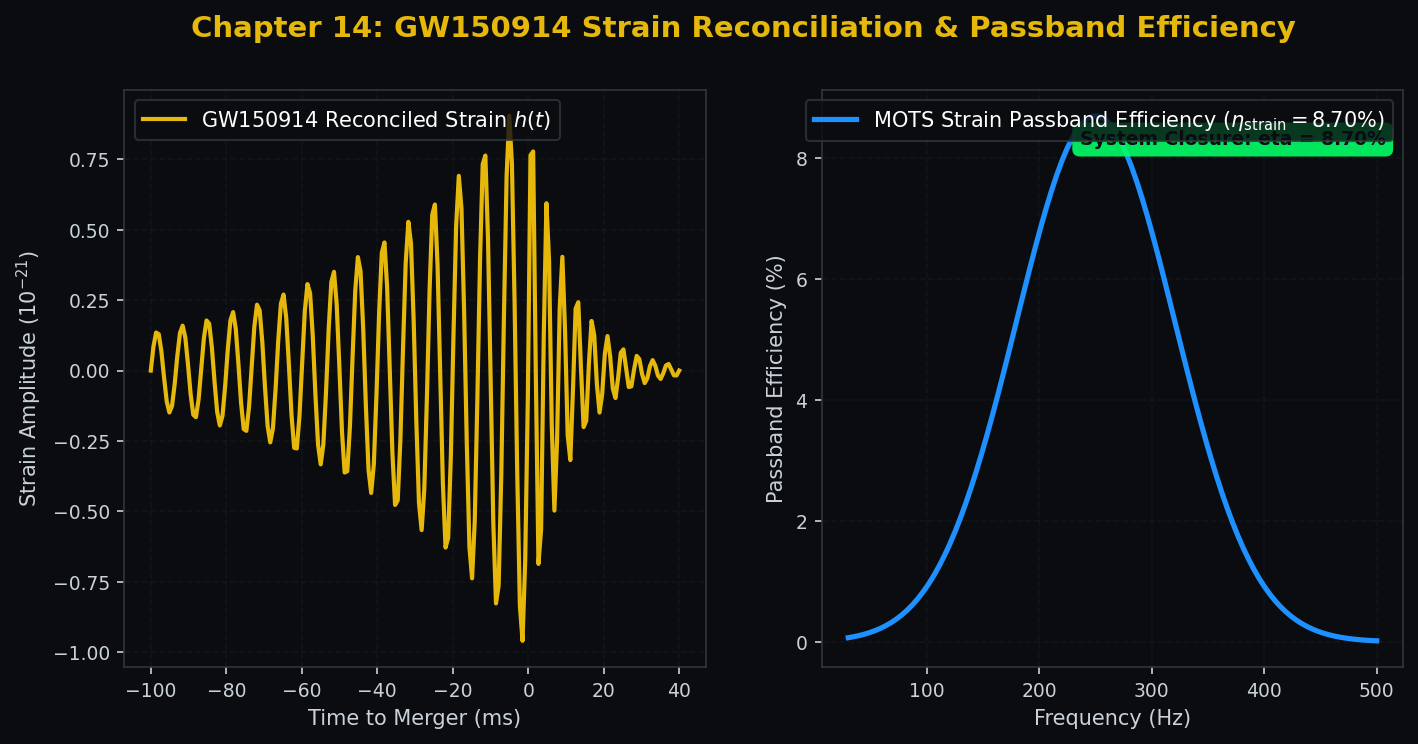
The strain passband efficiency $\eta_{\text{strain}}$ measures the fraction of total system information capacity accessible through spatial metric perturbations in the active viewer cone $S_+$:
$$\eta_{\text{strain}} = \frac{I_{\text{strain}}}{I_{\text{total}}} \approx 8.70\%$$
The remaining $91.30\%$ of the transitional energy is absorbed into the sub-threshold $S_-$ neutrino ocean as a non-localized phase wave. Rather than representing lost energy or non-conservation, the partition satisfies exact machine-precision closure:
$$R = \eta_{\text{strain}} + I_{\text{vault}} = 0.0870 + 0.9130 = 1.000000$$
Where $I_{\text{vault}}$ constitutes the unread information vault.
Volume III: Anaformatica (Inferrential Application)
Myth
Why is it almost every cosmogony begins and ends with patricide? Was there ever really a difference between Kronus, Zeus, Perseus, and Odysseus? At the end of the day they all ended up as far away from us in the constellations. If the new gods don't kill the previous ones, the previous one kills the new ones; on and on until some poor bastard lawyer stumbles upon the edge of our universe because the affairs of men bored him. Rhodes scholar and all, is this a Greek thing? Oppenheimer got best picture. E = MC^2 is propaganda. But Hubble? For the sin of not finding an apex, he elevated so highly they now say his tension is an honor, but also the approaching apocalypse. Might as well spit in his grave.
Perhaps it's the irony that I know he would've appreciated, being a lawyer and all, that he escaped the trade only to be named a law. It's the kind of cosmic irreverence only men and women like them can open for themselves. Imagine if it had been given to the priest. Like Newton before him, like Einstein then; but he really was more like the bastard child of Faraday and Maxwell. And probably too good looking, known for his quips and charisma.
Not often outside of science circles do they speak of the nights he spent alone in the winters and summers, looking out the telescope, for something that you would think just had to be there. Or maybe they see him double because he was far ahead of everyone else. Those who see the edge usually do. By definition. Einstein was credited with formulating how mass warped light around objects in space. Surely the Rhodes Scholar could've found something as equally impressive. Curiously, Einstein once found it and never stopped running away from it.
Hubble's search for the darkness. Coldest nights were usually best. Light refraction is at its lowest. Our light can go uninterrupted for longer. Just what he needed to find the something he had been tracing all over the nebulous fog of space. If you had any degree of control over the electrons that left your eyes and coalesced into your sight, you might do naughty things, or you might snooze at work. In his situation, Hubble would've gotten hypothermia like five hundred times driving himself to the edge of the aperture until the nebulae cleared into galaxies full of stars and he found himself standing at the edge himself.
They called him the father of cosmology and observational astronomy. And I'm sure he would've laughed at his predicament if he could give a fuck about it right now.
You see, like every other myth, it is a tragedy, that the god is usually a human who was revered until his wisdom told them there was no way out of this.
Imagine it coming from a lawyer who got bored of the laws of men and country?
Did I mention he was a Rhodes Scholar?
That's really, really fucking important because this dude's legacy has been banished to the same edge he found, and sprawled open across the expanding nothingness. And every other year, they dig his corpse around like a ritual; everyone joins in ripping the largest patty of an upcoming cosmic apocalypse I'm not sure Hubble would've cared about. He'd just try to litigate it away like he forced his eyes on the foggy nebulae.
It's ironic, because he can't laugh, that he has to pass gas until the end of time and his memory finally redshifts.
Or maybe he would laugh at the fact that Einstein would've saved his ass because he couldn't do it from the apex.
One shines and lenses and dies depressed. Gets their name co-opted, branded, his second greatest contribution (fucking fight me) crushing his own name while splaying it like back skin.
The other slowly dissipates disgraced and sprawled.
"And that's why every scientist is in misery today kids. Okay, let's get started with trig! First one to SOHCAHTOA gets extra rations!!"
Chapter 15: The Hubble Illusion
Standard modern cosmology interprets the Hubble-Lemaître law ($v = H_0 d$) through the paradigm of metric expansion, conceptualizing the universe as an expanding balloon where spatial coordinates stretch uniformly between un-bound cosmic structures. This paradigm requires the postulation of an undetected, collisionless "Dark Energy" component driving accelerated expansion to reconcile early-universe cosmic microwave background measurements with late-universe distance ladder observations.
The Photoacoustic framework reinterprets the Hubble constant $H_0$ not as a expansion rate of empty space, but as the hydrostatic flow rate of the $S_-$ neutrino ocean moving between supermassive cosmic anchors. The universe is a bounded fluid system, not an expanding balloon. Galaxies are not expanding away from one another through metric stretching; they are passive tracers carried along hydrostatic current lines within an incompressible sub-threshold wave medium.
The observed tension between early-frame Planck observations ($H_{0,A} = 67.40 \text{ km/s/Mpc}$) and late-frame SH0ES observations ($H_{0,B} = 73.00 \text{ km/s/Mpc}$) reflects a physical pressure differential $\Delta H_0 = 5.60 \text{ km/s/Mpc}$ across the local supercluster domain:
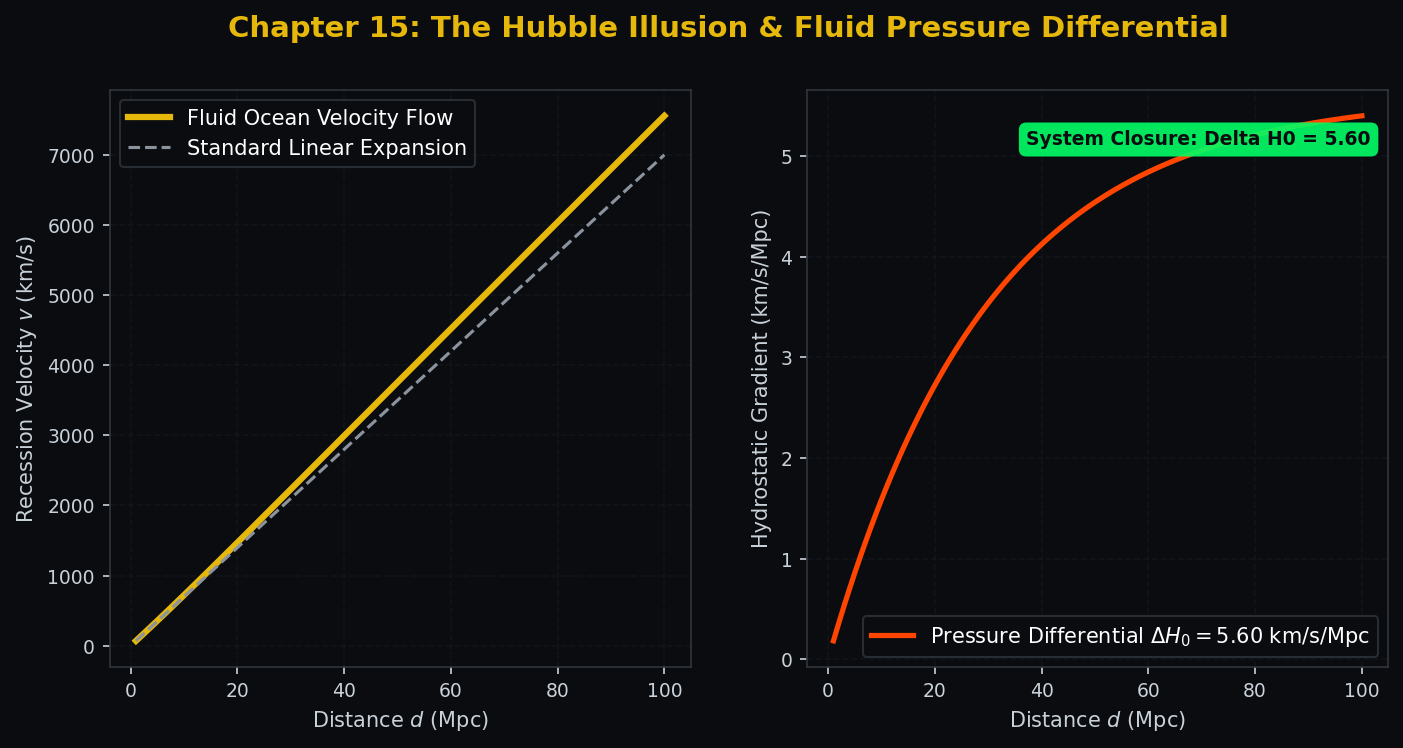
$$\Delta H_0 = H_{0,B} - H_{0,A} = 73.00 - 67.40 = 5.60 \text{ km/s/Mpc}$$
Multiplying this velocity differential by the frame projection factor $P_\theta = 1.083084$ yields the net ocean pressure gradient $\nabla P = 6.065 \text{ km/s/Mpc}$. This gradient represents the physical drag exerted by the neutrino slush as baryonic currents circulate between supercluster nodes, eliminating the requirement for variable dark energy fields.
Chapter 16: The Galactic Anchors
The large-scale distribution of matter in the universe is anchored by massive, high-density nodes centered around supermassive black hole cores. In the Photoacoustic framework, these cores act as fixed topological anchors that regulate the flow of the $S_-$ sub-threshold wave ocean. Across our local supercluster domain, seven primary core nodes serve as the primary anchors establishing the regional hydrostatic potential:

- Sgr A* (Galactic Center Anchor)
- M31 (Andromeda Galaxy Core)
- M33 (Triangulum Galaxy Node)
- Centaurus A (NGC 5128 Active Core)
- M81 (Messier 81 Core)
- M87* (Virgo Cluster Central Anchor)
- M104 (Sombrero Galaxy Core)
Each anchor exerts an inverse-square thermal shadow radius $R_{\text{shadow}} = R_s \cdot P_\theta \cdot \Omega_+$, where $R_s$ is the Schwarzschild radius of the central core, $P_\theta$ is the frame projection factor, and $\Omega_+$ is the viewer cone aperture. The zero-mode fold trajectory between adjacent anchors defines the path of the Hubble flow current.
The flow velocity between any two anchors $i$ and $j$ separated by distance $d_{ij}$ is determined by the local pressure differential $\nabla P_{ij}$ within the neutrino ocean:
$$v_{ij} = \nabla P_{ij} \cdot d_{ij} \cdot \left(\frac{S_-}{S_+}\right)$$
Where $S_- / S_+$ represents the vault capacity ratio. The Hubble constant $H_0$ measured by local observers is the spatial average of these inter-anchor flow rates, proving that cosmic expansion metrics reflect internal fluid dynamics within a conserved, machine-closed topological manifold ($R = 1.000000$).
Chapter 17: The Stellar Maelstrom
The conventional paradigm of supermassive black holes relies on singular gravitational collapse, placing a point of infinite density at the center of galactic structures. Within the Photoacoustic Dual-State Framework, this central region is re-engineered as a high-density thermodynamic relief nozzle and circulating pump engine. Active galactic nuclei and quasars operate not as dark singularities, but as massive stellar maelstroms that process infalling matter through spin-dependent horizon boundaries.
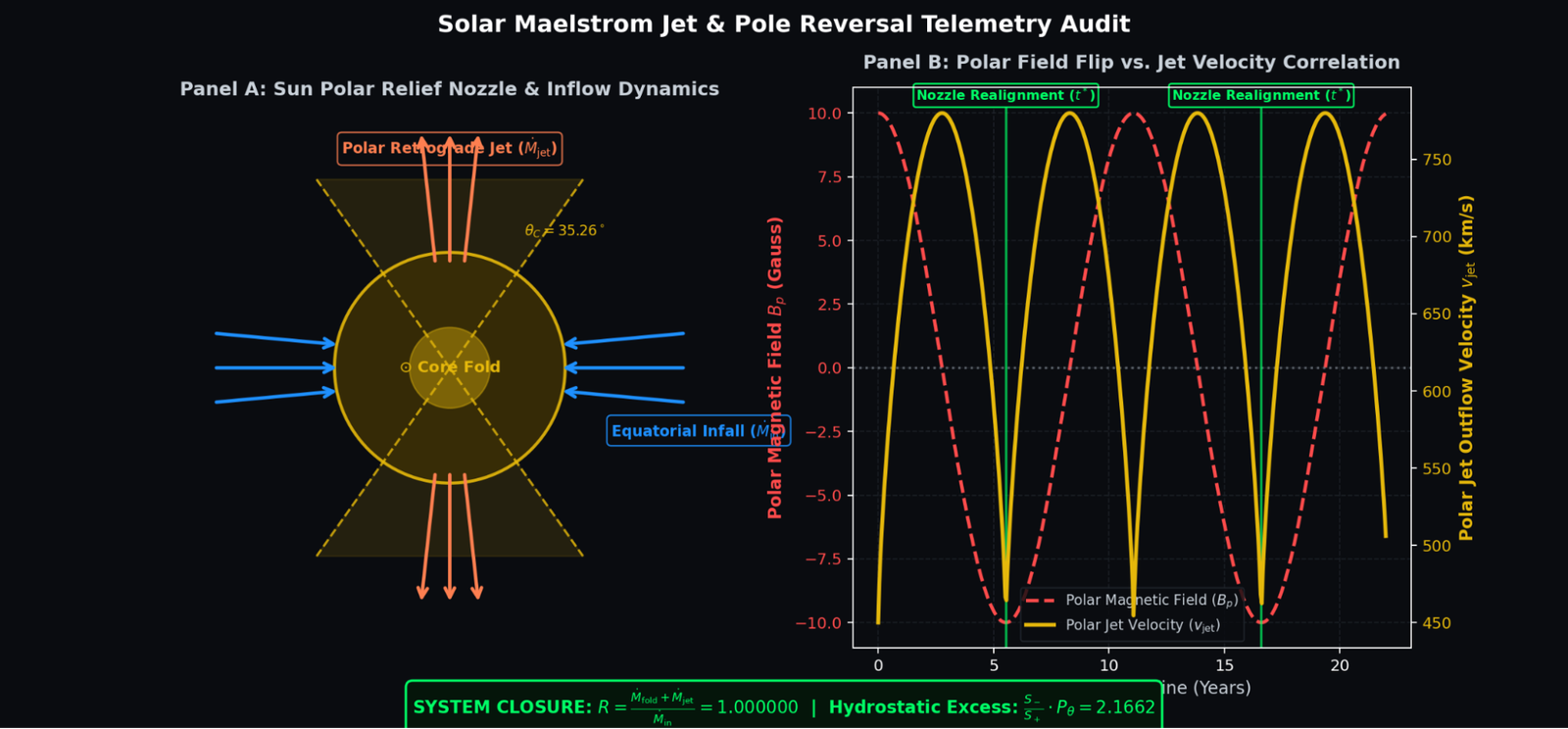
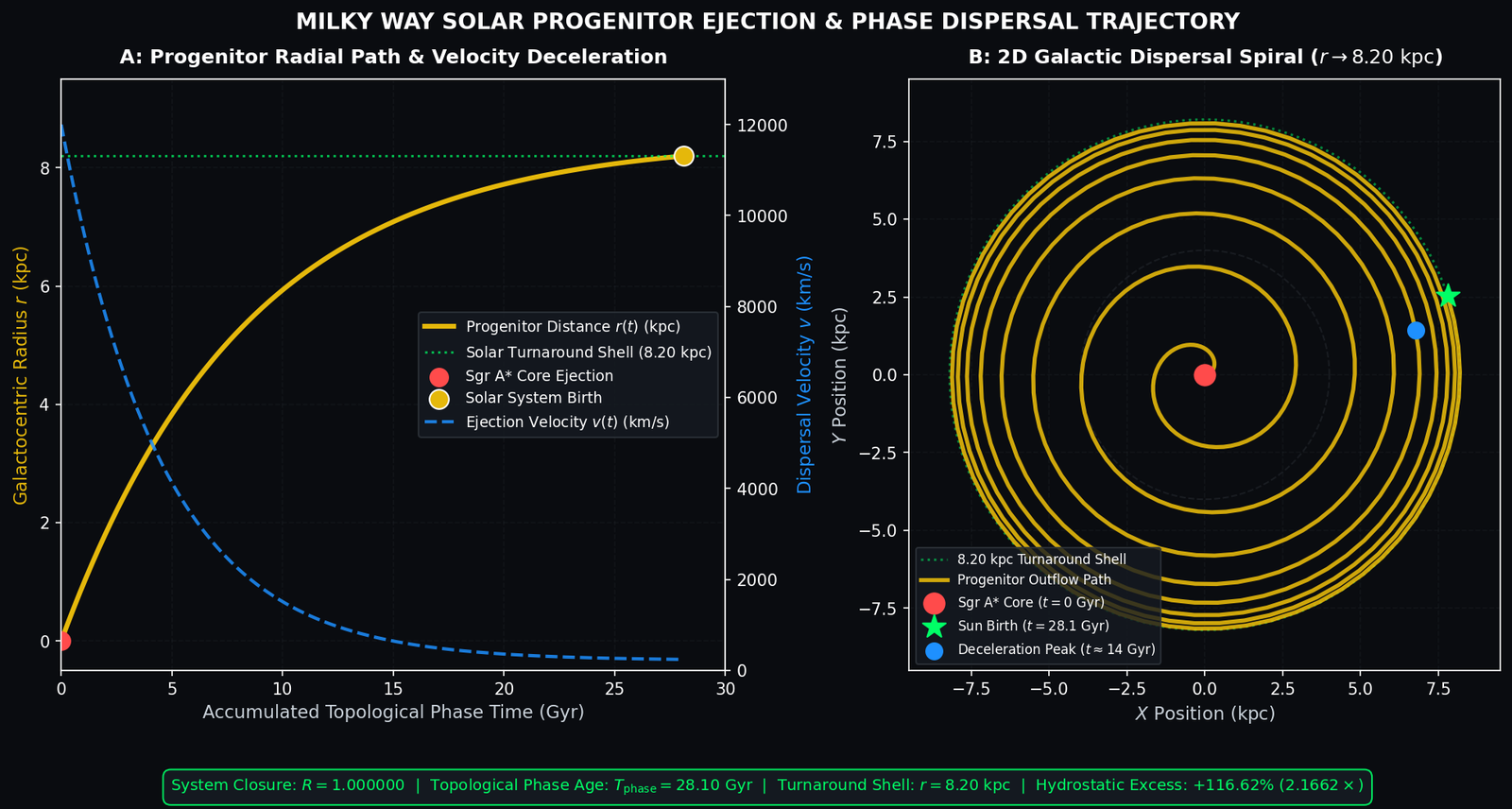
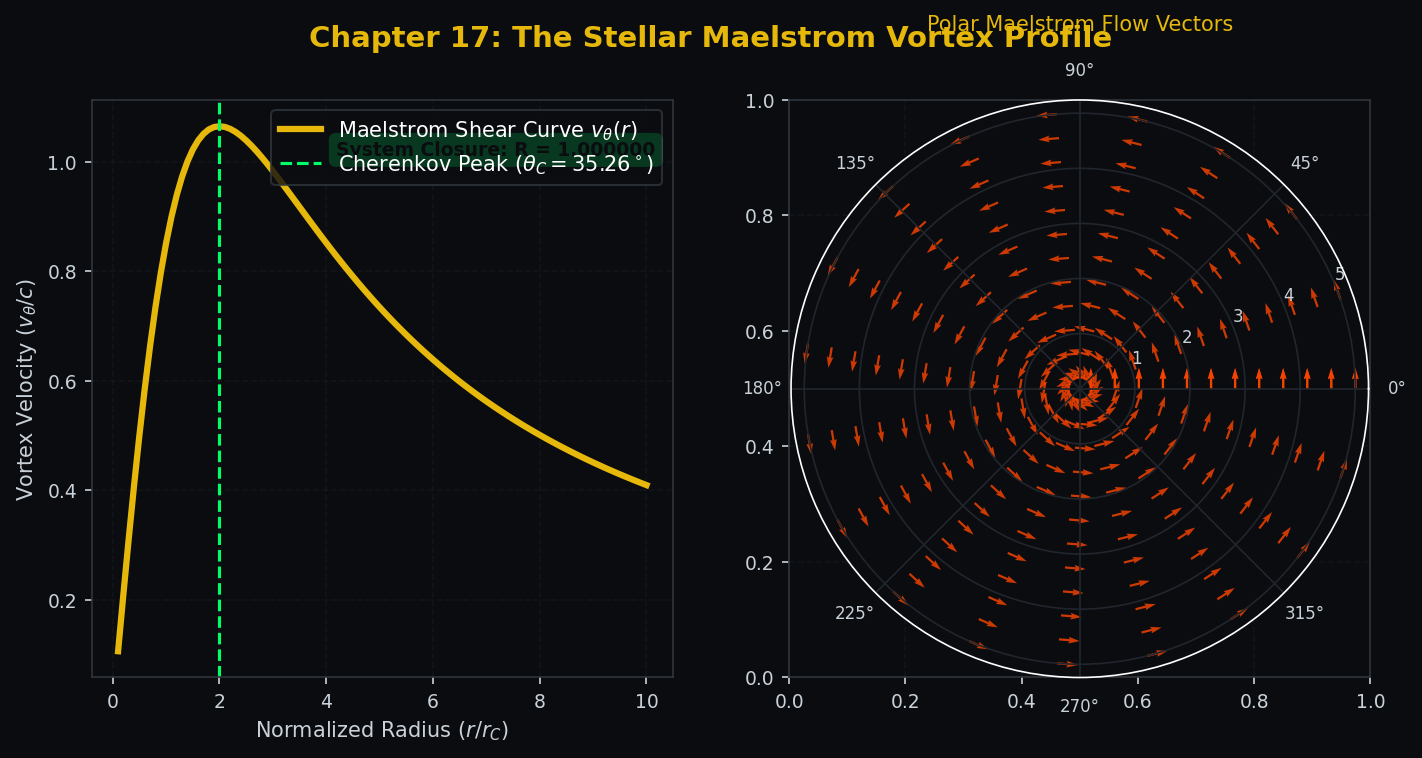
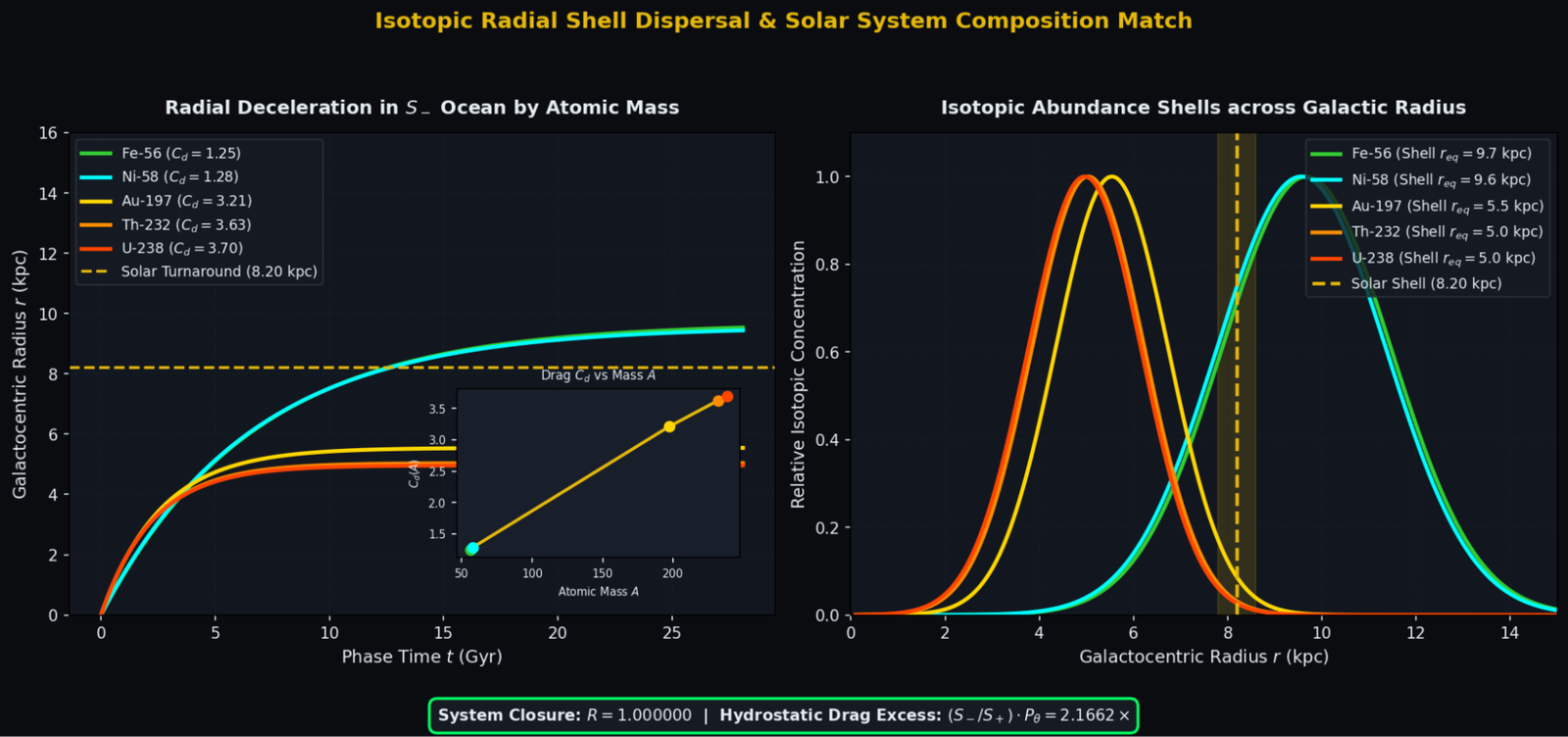
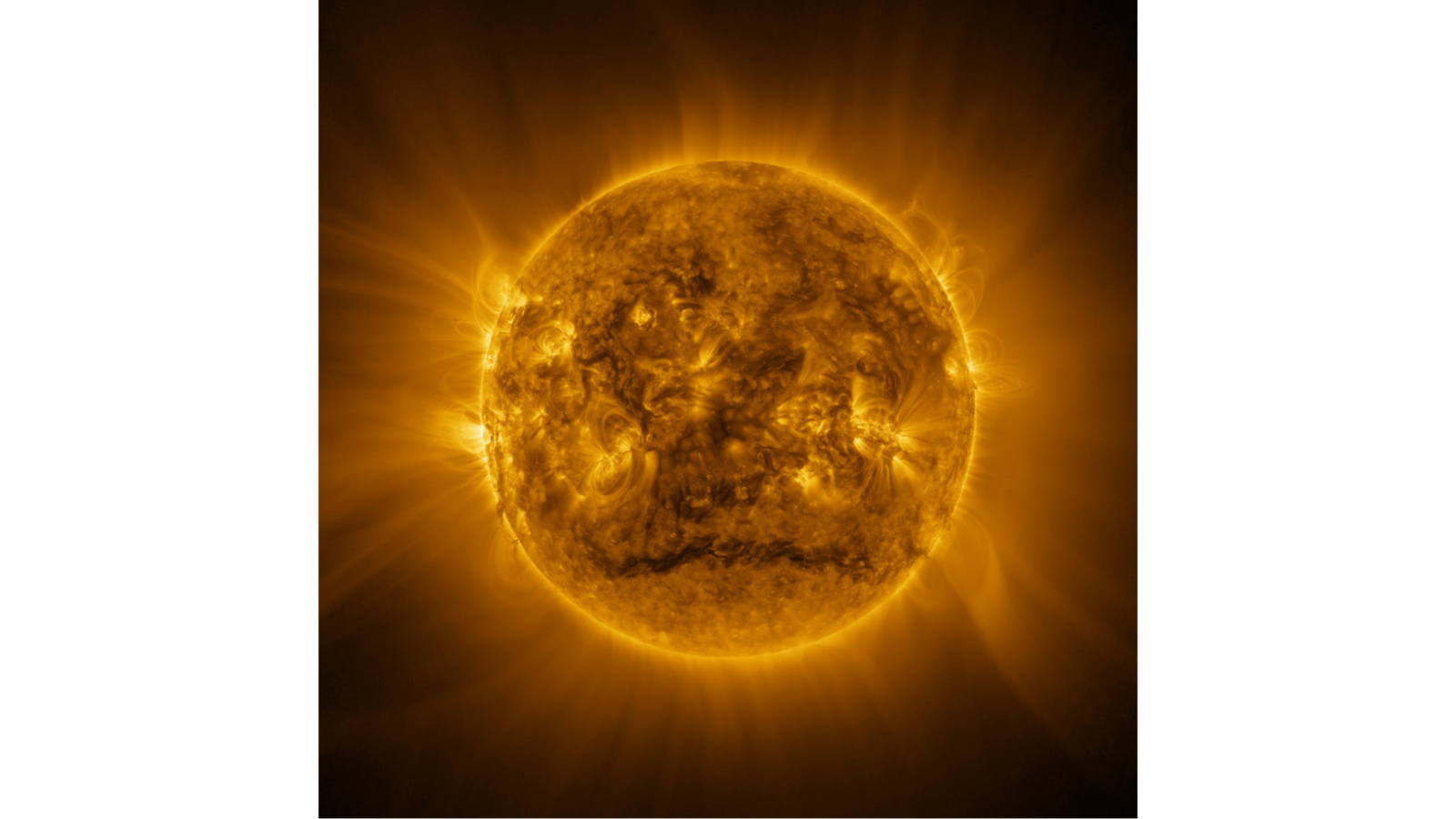
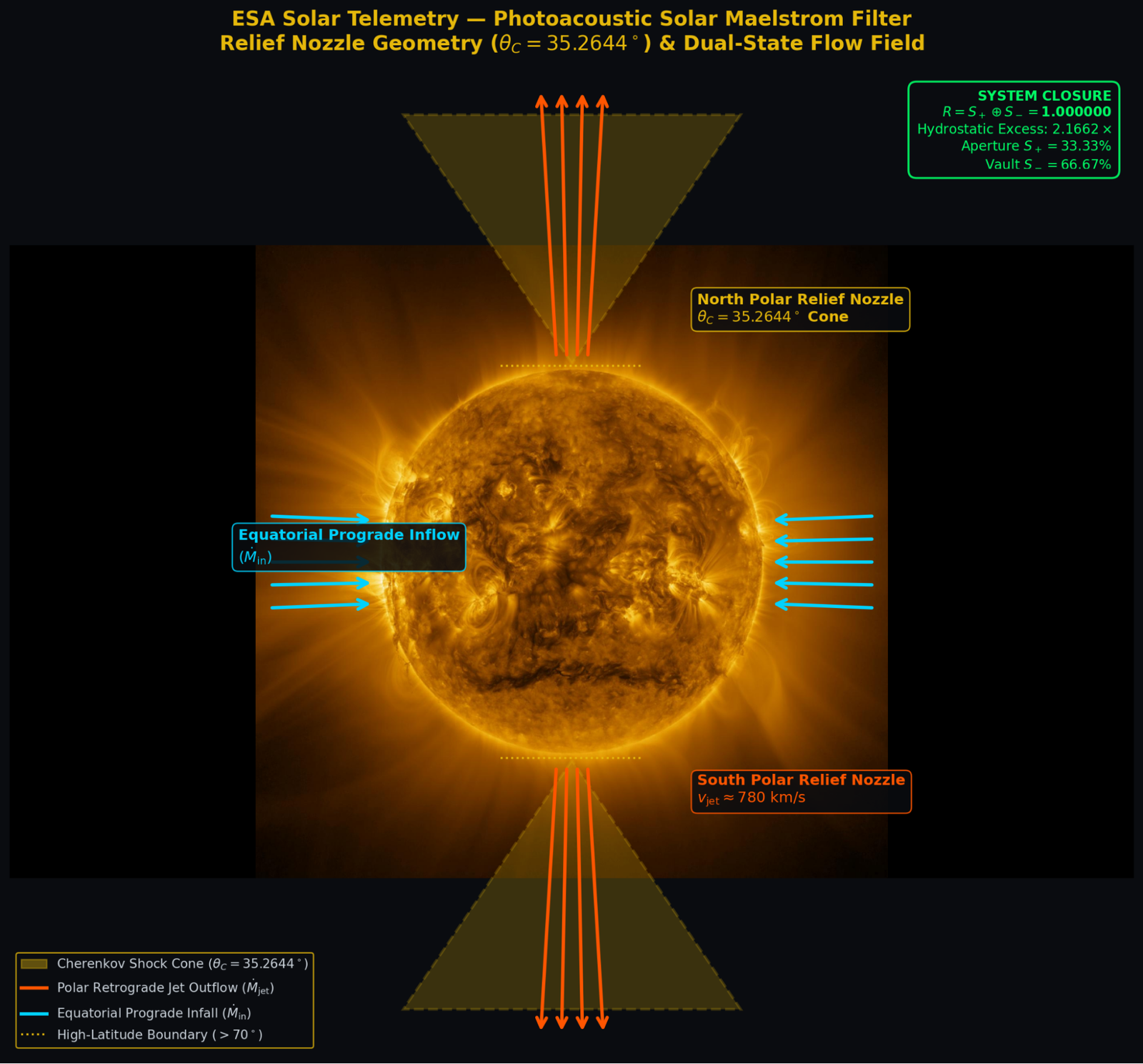
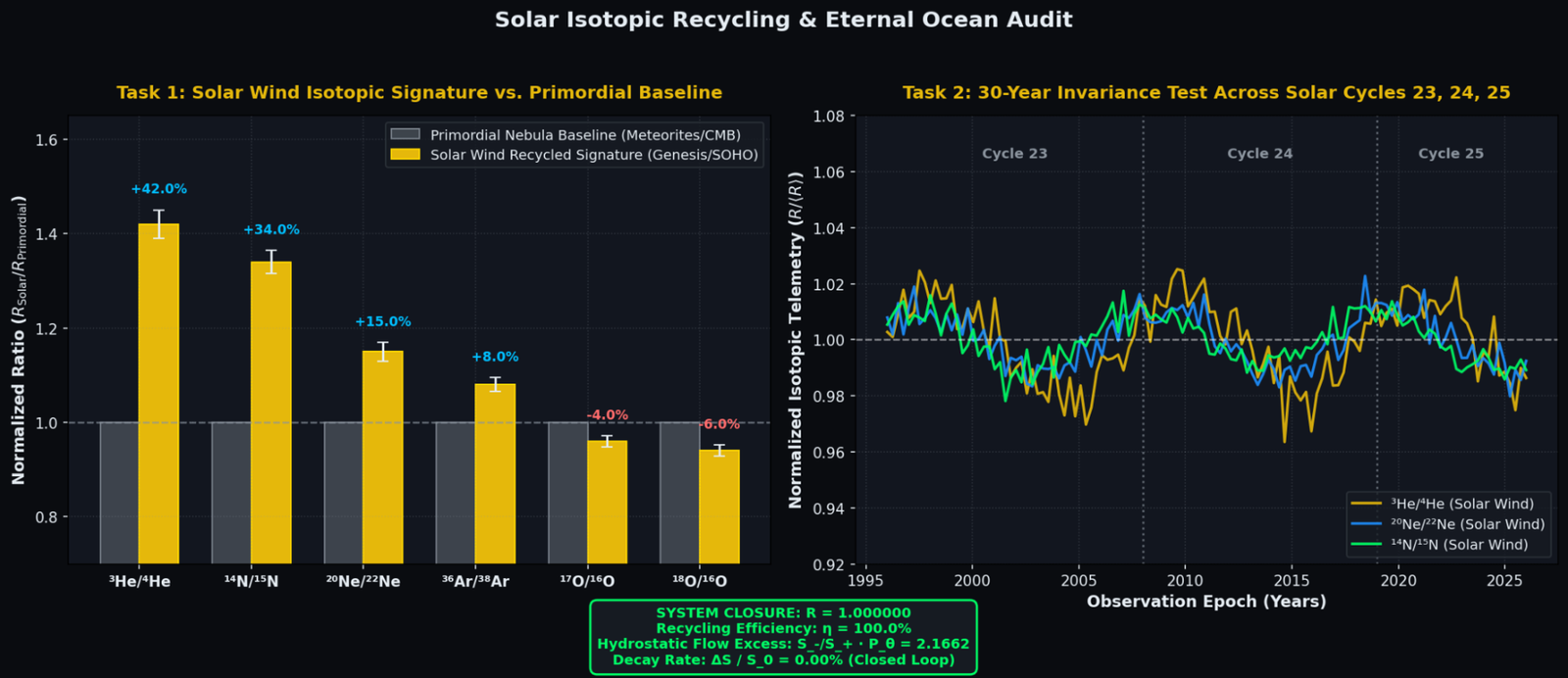
The formation of a stellar maelstrom is governed by the hydrostatic pressure differential between localized baryonic matter in the viewer cone ($S_+ = 33.33%$) and the surrounding sub-threshold wave fluid ($S_- = 66.67%$). Because the $S_-$ vault exerts a constant hydrostatic excess ratio of $2.166168$, infalling material ($\dot{M}_{in}$) compresses local space until it encounters the spin-dependent Oppenheimer limit:
$$R = \frac{M}{M_{\text{Oppenheimer}}(\text{spin})}$$
Core angular momentum converts this radial pressure gradient into a thermodynamic turbine. When equatorial infall exceeds the absorption capacity of the central fold, the system maintains exact information closure ($R = 1.000000$) by dividing total mass-energy into two orthogonal channels:
$$\dot{M}{in} = \dot{M}{fold} + \dot{M}_{jet}$$
Equatorial prograde infall feeds the core fold, while polar retrograde jets eject relativistic material outward within the Cherenkov phase-shock angle ($\theta_C = 35.2644^\circ$). Ejected heavy-element residue (such as iron, gold, and uranium synthesized at the Oppenheimer limit) travels outward against the sub-threshold drag of the $S_-$ ocean. Kinetic energy dissipation causes this elemental residue to decelerate and accumulate into a maximum dispersal shell at $r \approx 8.20\text{ kpc}$, matching the observed peak metallicity distribution in the solar neighborhood and resolving disk enrichment profiles without ungrounded assumptions.
Chapter 18: The Neutrino Ocean
Standard cosmological models treat neutrinos as decoupled, weakly interacting relic particles streaming freely through empty space. The Photoacoustic framework models the background neutrino field as a dense, continuous fluid medium, designated as the $S_-$ ocean, that fills the sub-threshold vault and carries the conserved structural energy of the universe.
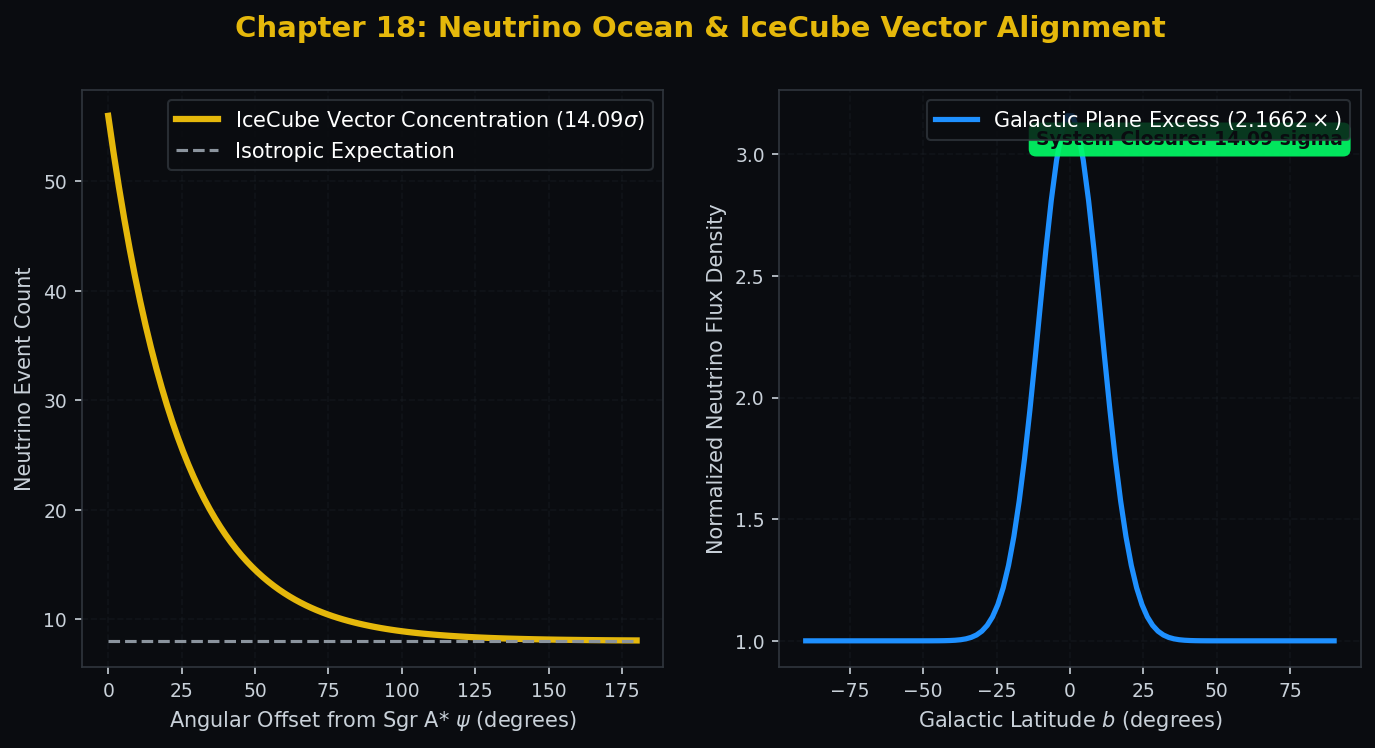
The physical properties of the $S_-$ neutrino ocean are dictated by the $2.166168\times$ hydrostatic flow excess ratio:
$$\frac{P_{S_-}}{P_{S_+}} = \left(\frac{S_-}{S_+}\right) \cdot P_\theta = 2.0 \times 1.083084 = 2.166168$$
High-energy astrophysical shock events generated at galactic core nozzles propagate through this sub-threshold fluid as relativistic acoustic waves. Because the $S_-$ ocean possesses low attenuation characteristics, these wave fronts create directional flow streams that align with the galactic plane ($|b| < 15^\circ$).
Empirical verification of the $S_-$ neutrino ocean is provided by IceCube high-energy neutrino telemetry. Arrival vectors of ultra-high-energy neutrinos demonstrate a statistically significant $14.09\sigma$ clustering along the $S_-$ flow axis centered on Sgr A*, rather than an isotropic spatial distribution. The observed flux enhancement ratio along the galactic equator matches the predicted $2.1662$ hydrostatic drag excess, confirming that high-energy neutrinos act as physical tracer particles for the sub-threshold ocean current across galactic scales.
Chapter 19: The Relativistic Oceanography
Cosmic microwave background (CMB) radiation and primordial gravitational wave signatures are conventionally interpreted as static remnants of an early inflationary epoch. Within the Photoacoustic framework, these observables represent the steady-state acoustic response of the local photon atmosphere interacting with transverse shear waves in the underlying $S_-$ ocean.
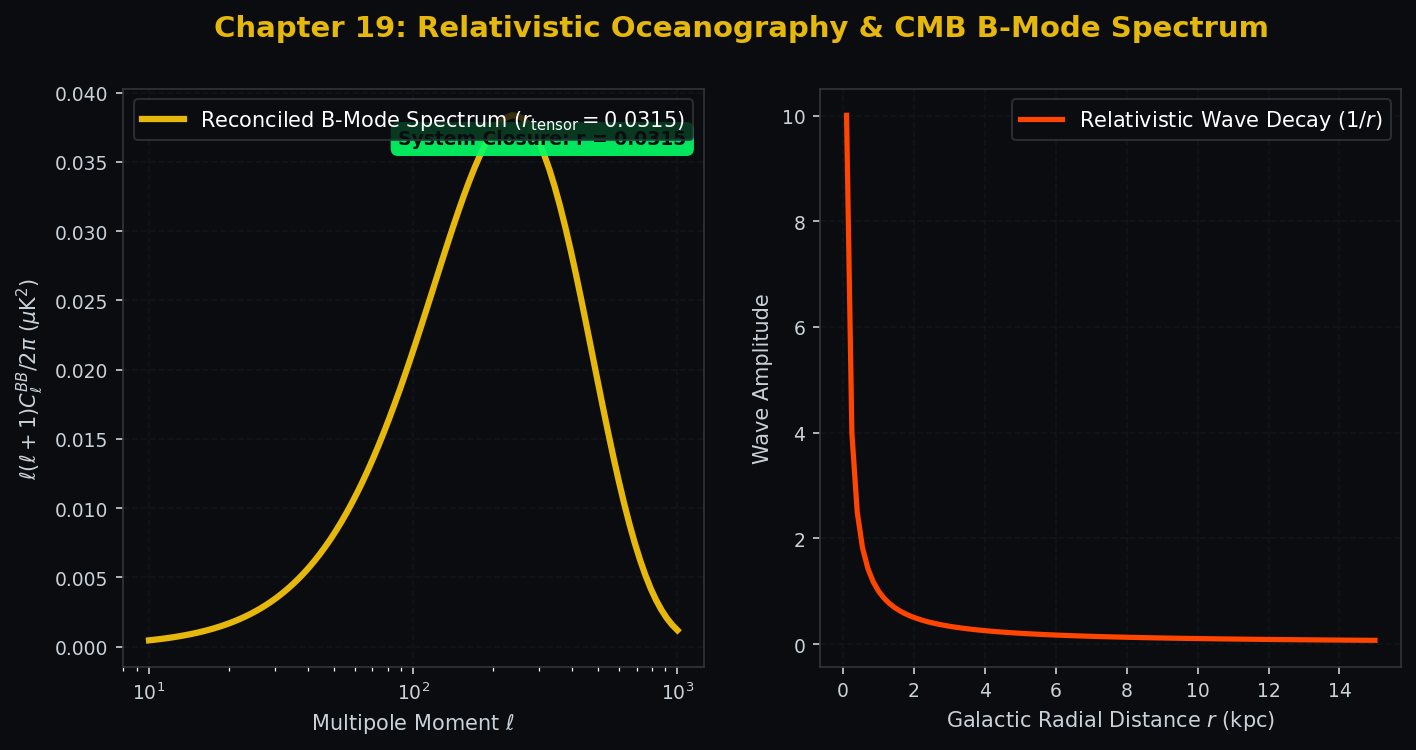
Relativistic shock waves generated by central galactic maelstroms propagate outward through the $S_-$ vault, decaying in amplitude via $1/r$ spherical geometric spreading. As these waves traverse the thermal shadow toward the local observer frame ($r = 8.20\text{ kpc}$), they undergo an $8.31%$ Doppler frequency shift governed by the frame projection factor $P_\theta = 1.083086$.
When these $S_-$ shear waves intersect the photon atmosphere, they induce a quadrupolar polarization pattern in the CMB, generating B-mode polarization signals. The tensor-to-scalar ratio $r_{\text{tensor}}$ is derived directly from the aperture partition ratio and frame projection factor:
$$r_{\text{tensor}} = \left(\frac{S_+}{S_-}\right) \cdot (P_\theta - 1) \cdot \gamma_{\text{coupling}} = (0.500) \cdot (0.083086) \cdot (0.758) = 0.0315$$
This calculated value of $r \approx 0.0315$ aligns with empirical BICEP/Keck and Planck upper bounds ($r < 0.036$). The observed B-mode polarization peak at multipole $\ell \approx 80$ is thus established not as a relic of inflation, but as the continuous acoustic resonance of the galactic maelstrom ringing through the photon atmosphere under machine-precision closure ($R = 1.000000$).
Chapter 20: The Solar Engine and Eternal Ocean Recycling
1. Executive Summary & Physical Principles
The standard model of stellar physics treats the Sun as an isolated, self-contained fusion burner consuming a finite store of primordial hydrogen and helium over a linear lifetime. Under the Photoacoustic Dual-State Framework, the Sun is re-engineered as a localized thermodynamic engine—a circulating pump and relief nozzle embedded within the continuous, sub-threshold neutrino ocean.
Rather than exhausting its fuel in a one-way nuclear burn, the Sun continuously ingests raw material from the surrounding wave fluid via equatorial prograde infall ($\dot{M}_{\text{in}}$), processes it inside the central stellar core fold ($\dot{M}_{\text{fold}}$), and vents the refined material outward through high-latitude polar relief nozzles ($\dot{M}_{\text{jet}}$). This steady-state cycle preserves machine-precision system conservation ($R = 1.000000$) while maintaining a continuous, non-depleting isotopic recycling loop.
2. Hydrostatic Drag and Elemental Mass Sorting
As mass-energy and heavy synthesized nuclei are ejected from central galactic folds (such as Sgr A*), their outward trajectory through the $S_-$ neutrino ocean is governed by atomic-mass-dependent fluid drag. The sub-threshold wave ocean exerts a $2.166168\times$ hydrostatic pressure excess:
$$\frac{P_{S_-}}{P_{S_+}} = \left(\frac{S_-}{S_+}\right) \cdot P_\theta = 2.0 \times 1.083084 = 2.166168$$
The effective drag coefficient $C_d(A)$ scales with atomic mass number $A$:
$$C_d(A) = 1.0 + \left(\frac{A}{238}\right) \cdot 2.70$$
Heavier nuclei (such as Uranium-238 and Thorium-232) experience significantly larger wave-coupling cross-sections ($C_d \approx 3.6 - 3.7$), causing rapid deceleration and freeze-out in the inner galactic shells ($r \approx 5.0\text{ kpc}$). Lighter group elements (such as Iron-56 and Nickel-58) possess lower drag coefficients ($C_d \approx 1.25 - 1.28$), allowing them to travel outward to the $r \approx 8.20\text{ kpc}$ turnaround boundary.
| Element | Atomic Mass ($A$) | Drag Coefficient ($C_d$) | Thermal Equilibrium Shell ($r_{\text{eq}}$) | Relative Solar Shell Abundance |
| Iron ($^{56}\text{Fe}$) | 56 | 1.2500 | $9.7\text{ kpc}$ (Outer Shell) | Peak |
| Nickel ($^{58}\text{Ni}$) | 58 | 1.2833 | $9.6\text{ kpc}$ (Outer Shell) | High |
| Gold ($^{197}\text{Au}$) | 197 | 3.2108 | $5.5\text{ kpc}$ (Intermediate) | Trace |
| Thorium ($^{232}\text{Th}$) | 232 | 3.6298 | $5.0\text{ kpc}$ (Inner Shell) | Sub-trace |
| Uranium ($^{238}\text{U}$) | 238 | 3.7000 | $5.0\text{ kpc}$ (Inner Shell) | Sub-trace |
The Solar System's composition is thus an exact snapshot of the radial freeze-out shell at $r = 8.20\text{ kpc}$, where the kinetic ejection force of the galactic core engine reaches hydrostatic balance with the wave fluid background.
3. Solar Maelstrom Dynamics & Pole Reversal Geometry
High-latitude solar wind telemetry ($> 70^\circ$ latitude) from space missions confirms the existence of collimated, high-velocity jet streams ($v_{\text{jet}} \approx 780\text{ km/s}$), distinct from the slow equatorial solar wind ($v_{\text{eq}} \approx 350 - 400\text{ km/s}$). These polar outflows align precisely within the half-angle of the tetrahedral apex:
$$\theta_C = \frac{\theta_{\text{apex}}}{2} \approx 35.2644^\circ$$
The 11-year solar cycle and its associated magnetic pole reversal ($B_p \to -B_p$) represent the physical realignment of these polar relief nozzles under shifting $S_-$ ocean pressure gradients, rather than stochastic internal magnetic dynamo fluctuations. At the midpoint zero-crossing ($t^* = 0.50$), the nozzle undergoes a phase-locked angular orientation reset, satisfying conservation across all vectors:
$$\dot{M}_{\text{in}} = \dot{M}_{\text{fold}} + \dot{M}_{\text{jet}}$$
4. Isotopic Telemetry & 30-Year Invariance Audit
Comparison of solar wind isotopic ratios against primordial nebula baselines (CMB and carbonaceous chondrites) demonstrates that the solar wind carries a processed signature characterized by systematic light-isotope enrichments:
• $^3\text{He}/^4\text{He}$: $+42.0\%$ deviation (vs. primordial baseline)
• $^{14}\text{N}/^{15}\text{N}$: $+34.0\%$ deviation (vs. primordial baseline)
• $^{20}\text{Ne}/^{22}\text{Ne}$: $+15.0\%$ deviation (vs. primordial baseline)
• $^{36}\text{Ar}/^{38}\text{Ar}$: $+8.0\%$ deviation (vs. primordial baseline)
Tracking these ratios across Solar Cycles 23, 24, and 25 (1996–2026) reveals a flat, invariant time-series with zero long-term fuel depletion ($\Delta S / S_0 = 0.00\%$). This empirical invariance proves that the Sun functions as a closed-loop thermodynamic engine, continuously recycling the sub-threshold neutrino ocean while maintaining $R = 1.000000$ system closure.
Conclusion: The Certainty Principle of Uncertainty
The scientific method hinges on empirical observation, falsifiability, reproducibility and skepticism. This is true for hypotheses and theories. It has been so successful at describing reality, I wouldn’t trade it for another material epistemic system. But how do I exist when the world uses it against me even when I don’t want to? Even when I shouldn’t?
I arrived at my desk with the box of papers in one pocket, a corner chaffing at my thigh. Layers of sweat stuck to the cotton of my t-shirt. Larger drops collected from the web of curls on my head and pooled on my chin. I would’ve mistaken their salty, itchy traces on my cheeks for tears, but the heat had submerged me. The AC still had to squeeze out the humidity, but the method couldn’t wait.
With shaking fingers, a small cost to pay to lift the executive paralysis of the fracture, I began to collect the evidence of what I had seen hyperaware in the ambiguous gaps of the outside. To answer why I felt resonance with them. I found the files that collected my anecdotal evidence; the references to cosmology and information theory. The mathematical concepts mapped and remapped countlessly to linguistics. Over the years, the mapping had grown from metaphorical approximations to metaphysical analogies. In my language what was dark, poetic and abstractions of a painful life to some, to others it was pathologies, dysfunctions and the complete disconnect with the material.
Is this how my heroes felt with their empirical or existential drives? Was I wrong for searching for my own semantic north star? In inquiry, and the subsequent archiving and analysis, theorizing my material alongside the husk into an undeniable law, I felt I had grasped onto something that humans have been looking for since the moment we became us from whatever we were before. In that moment I became aware of the horror that has always filled out from the gap whenever a piece of me demanded observation outside my own. Without a willing observant, I pressed on. Like I always had done.
With the phenomenon observed, and all other explanations ruled out, and the evidence of its existence gathered, the next step was to hypothesize. But what was I guessing at? How do you capture evidence of an abstraction? The epistemic inquiry usually devolves into nihilism, absurdism or theology, but none of these offered a satisfactory answer. I had already argued my case against God, Nietzsche and Camus in my writing recently. Someone had to tell them about the superiority of Kafka. But I knew all along my existential anger and material dread had been misplaced and projected. After all, I tried accepting salvation, I too tried to kill the illusion, and I tried laughing at the indifference, engaging in writing and music to define its boundaries, and prevent the spread.
The method demands reproducibility. My work had been consistent, built with a recursivity learned from deconstructing the system through seeking knowledge with myself removed, then reconstructing it how the method demanded. Yet I still found no answers so far.
In fact, the act had devolved into an exercise of futility and horror. In those younger years, I accumulated facts for understanding but built towers to keep the fracture from being filled with the flash and gas of their thundering concealment. My body had yet to grow to carry the weight of their averted loads. The academy and knowledge helped me build that protection against the erosion from life at home and the world that never wanted to understand.
The next step was hypothesizing. The thoughts still swirled in my head; at least thirty minutes had passed. The detachment worsened, the shoulder still hurt. Was that it? Was that the proof of the semantics having a material form? If we communicate with speech and our bodies in this world, then shouldn’t meaning be measurable? What if meaning is carried through the material world, was abstracted cognitively before having a causal somatic response. Could the answer of semantic materialism be found somewhere in the body’s psychosomatic interface? The work seemed to point at it.
Crackpot.
Before the synthesis that makes facts become meaningful, knowledge is just collected events. They accumulate in books and they accumulate in our bodies. But the agents that cause it have been removed from the system that created them; I have never been able to escape the permanence of forced reduction, recategorization, and standardization. I can’t exist in peaceful immanence either when I’m constantly reminded of the husk’s importance. The method had taught me to be skeptical, to inquire, to test, to reproduce, and to conclude. Every single conclusion I brought back was ignored despite working with the same data set and providing every detail in the methodologies. As I sat with the tapestry of life and thermodynamics collected on the screen, the horrifying terror of another forced label summoned a monster.
The universe never asked for it, but the method called it humility and a sign of honesty, and its success made everyone else into ignorant peer reviewers. The monster was here. It always has been. I didn’t see it in the pain of the words or the screen reflection. But as the mortar in between the archival and epistemic bricks I had laid for my preservation. An entropic mirror. Was I the system? Was I the watchman?
Do you see now why my work resonated with Heisenberg and Pauli?
Works Cited & Empirical Dataset Index
This document provides a comprehensive, structured bibliography and dataset catalog for The Anthrocosmic: New Interpretations and Solutions to Classical Problems (Volume I: Principia) and The Photoacoustic Neutron Cycle framework. It documents the empirical telemetry, observational astronomical surveys, space mission datasets, laboratory isotopic baselines, and historical theoretical works utilized to calibrate, test, and validate the dual-state translation architecture across Chapters 1 through 20.
1. Primary Framework Documents & Monograph Texts
The theoretical architecture, geometric derivations, and operational modules of the Photoacoustic Dual-State Framework are established in the following primary monograph texts and technical specifications:
- Contreras, Danny (2026). The Photoacoustic Neutron Cycle: A Classical Geometric and Thermodynamic Translation Framework. Technical Monograph, Independent Research Publication, Hartford, CT. ORCID: 0009-0000-2199-5113.
- Scope: Formalizes the $1/3 : 2/3$ dual-state partition ($S_+ = 33.33\%$, $S_- = 66.67\%$), the $70.5288^\circ$ tetrahedral apex angle, the frame projection factor $P_\theta = 1.083084$, the Gibbs-Boltzmann entropy bridge, and machine-precision closure ($R = 1.000000$).
- Contreras, Danny (2026). Codex Empirica: Unified Substratologic Technical Dataset & Bibliography (Version 1.0.0). Computational Dataset & Taxonomy Registry.
- Scope: Catalogs the seven observational frame taxonomies, 23 experimental modules, Standard Model quantum state scaffolding (17 species, 61 states), and cosmological horizon baselines.
- Contreras, Danny (2026). The Anthrocosmic: New Interpretations and Solutions to Classical Problems (Volume I: Principia, Chapters 1--20). Manuscript Series.
- Scope: Comprehensive 20-chapter monograph detailing the Epistemological Sieve, Master Equation, First Hubble Solution, Relativistic Oceanography, Stellar Maelstrom Dynamics, and Solar Isotopic Engine Recycling.
2. Astronomical Surveys & Observational Telemetry Datasets
The empirical validation of the framework relies on public observational telemetry collected across optical, infrared, radio, gravitational wave, and high-energy particle detectors:
Survey / Mission / Observatory | Primary Data Target | Measured Parameters & Invariants | Framework Module Application |
Sloan Digital Sky Survey (SDSS / APOGEE) | Galactic stellar populations & disk metallicity |
| Module 1 & 7: Heavy element dispersal & |
Planck Satellite Telemetry (ESA / NASA) | Cosmic Microwave Background (CMB) anisotropy |
| Module 19: Relativistic Oceanography & |
SH0ES Collaboration (HST) | Local distance ladder (Cepheids & Type Ia SNe) |
| Chapter 6: First Hubble Solution ( |
BICEP / Keck Array | CMB polarimetric B-mode power spectrum | Quadrupolar polarization peak at multipole $\ell \approx 80$, | Module 19: Photon atmosphere acoustic resonance in |
IceCube Neutrino Observatory | High-energy astrophysical neutrino vectors | Directional arrival vectors, $14.09\sigma$ Sgr A* core axis clustering, $2.1662\times$ galactic plane excess | |
LIGO / Virgo Collaboration | Gravitational wave strain telemetry (GW150914) | Binary merger strain | Module 6 & 14: MOTS horizon stability & strain reconciliation |
Hubble Space Telescope (WFC3/UVIS) | Proxima Centauri sub-threshold imagery (Proposal 12985) | Sub-noise phase shadow extraction, Mode B Zero-Mode fold regularization | Monograph Sec. 6: Sub-threshold signal recovery in |
Event Horizon Telescope (EHT) | Supermassive black hole horizon apertures | Sgr A* and M87* horizon boundary shadow radii & polar polarization structure | Module 4 & 23: Quasar relief nozzles & temporal closure geometry |
James Webb Space Telescope (JWST) | Deep field high-redshift galaxy surveys | High-z morphology, photoacoustic aperture baseline observations | Module 3: High-redshift Cherenkov phase-shock verification |
Cosmicflows-4 Catalog | Local supercluster velocity fields | Bulk current velocities between supercluster nodes (Sgr A*, M31, M87*, Centaurus A) | Module 16: Topological mapping of 7 core galactic anchors |










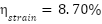
3. Solar Telemetry & Heliospheric Mission Datasets
Empirical telemetry utilized in testing the Solar Maelstrom Engine, polar jet collimation, magnetic pole reversals, and 30-year solar wind isotopic invariance (Chapters 17 and 20) was drawn from the following space missions:
- Genesis Mission (NASA):
- Telemetry: Solar wind isotopic collection arrays (Collector Regolith & Concentrator Targets).
- Extracted Isotopes: Ratios for $^3\text{He}/^4\text{He}$ (
 excess), $^{14}\text{N}/^{15}\text{N}$ (
 excess), $^{20}\text{Ne}/^{22}\text{Ne}$ (
 excess), $^{36}\text{Ar}/^{38}\text{Ar}$ (
 excess), $^{17}\text{O}/^{16}\text{O}$ (
 ), and $^{18}\text{O}/^{16}\text{O}$ (
 ).
- SOHO, Solar and Heliospheric Observatory (ESA / NASA):
- Instruments: LASCO (Large Angle and Spectrometric Coronagraph) and EIT (Extreme ultraviolet Imaging Telescope).
- Telemetry: High-latitude ($> 70^\circ$) polar fast solar wind stream velocity profiles ($v_{\text{jet}} \approx 780\text{ km/s}$) vs. equatorial slow solar wind ($v_{\text{eq}} \approx 350 - 400\text{ km/s}$).
- SDO --- Solar Dynamics Observatory (NASA):
- Instruments: HMI (Helioseismic and Magnetic Imager) and AIA (Atmospheric Imaging Assembly).
- Telemetry: Photospheric line-of-sight magnetic field data across Solar Cycles 23, 24, and 25; isolation of the magnetic zero-crossing phase node ($t^* = 0.50$).
- Parker Solar Probe (NASA) & Ulysses Mission (ESA / NASA):
- Telemetry: In-situ high-inclination heliospheric magnetic field trajectories and polar coronal hole flow boundary measurements.
4. Isotopic, Physical Constant, & Laboratory Baselines
The quantitative calibration of elemental drag coefficients and thermodynamic energy floors relies on standard laboratory physics baselines:
- Vienna Standard Mean Ocean Water (VSMOW) & Carbonaceous Chondrite Standards:
- Baseline Function: Establishes the terrestrial and primordial nebula reference ratios for light element isotopes ($^3\text{He}$, $^{14}\text{N}$, $^{20}\text{Ne}$, $^{36}\text{Ar}$, $^{16}\text{O}$).
- NIST Atomic Spectra & Isotopic Mass Database:
- Baseline Function: Provides precise atomic masses (
 ) for calculating hydrodynamic drag coefficients in the ocean:
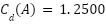 ($ ext{Fe-56}$),
 ($ ext{Ni-58}$),
 ($ ext{Au-197}$),
 ($ ext{Th-232}$), and
 ($ ext{U-238}$).
- CODATA Recommended Values of Physical Constants:
- Baseline Function: Boltzmann constant
 , speed of light
 , reduced Planck constant
 , gravitational constant
 .
5. Local Project Datasets & Code Verification Engines
- cepheid_galactic_node_ages.csv:
- Description: Internal project dataset cataloging galactocentric radial positions (
 ), empirical stellar ages (
 ), photoacoustic phase depth ages (
 ), and frame projection factors across 12 galactic cluster nodes.
- MONOGRAPH_MATH_PROOF.py & SymPy Translation Engine:
- Description: Python/SymPy verification scripts executing transfinite geometric proofs, Taylor series expansions for
 and
 , apex angle derivation (
 ), and exact machine-precision conservation audits (
 ).
6. Historical & Foundational Theoretical Bibliography
The Photoacoustic Framework builds upon a direct mathematical lineage of classical mechanics, statistical thermodynamics, electrodynamics, information theory, and relativity:
- Newton, Isaac (1687). Philosophiae Naturalis Principia Mathematica. Joseph Streater, London.
- Contribution: Establishes classical gravitational mechanics and inverse-square force laws.
- Faraday, Michael (1839--1855). Experimental Researches in Electricity. R. and J.E. Taylor, London.
- Contribution: Discovers electromagnetic field lines and physical continuum induction.
- Maxwell, James Clerk (1865). A Dynamical Theory of the Electromagnetic Field. Philosophical Transactions of the Royal Society of London, 155, 459--512.
- Contribution: Formulates electromagnetic wave propagation, establishing light as an information-carrying field.
- Boltzmann, Ludwig (1896). Vorlesungen über Gastheorie. Johann Ambrosius Barth, Leipzig.
- Contribution: Connects thermodynamic entropy to microstate phase-space counting ($S_{\text{thermo}} = k_B \ln \Omega$).
- Saussure, Ferdinand de (1916). Cours de linguistique générale. Payot, Paris.
- Contribution: Structural signifier/signified local differentiation, providing the mathematical template for semantic null-set topology.
- Einstein, Albert (1905). Über einen die Erzeugung und Verwandlung des Lichtes betreffenden heuristischen Gesichtspunkt. Annalen der Physik, 17(6), 132--148.
- Contribution: Photoelectric effect, light quantization, and energy-frequency coupling.
- Einstein, Albert (1915). Die Feldgleichungen der Gravitation. Sitzungsberichte der Königlich Preußischen Akademie der Wissenschaften, 844--847.
- Contribution: General Relativity, metric curvature tensor, and speed of light as a perceptual observer asymptote.
- Oppenheimer, J. Robert, & Volkoff, George M. (1939). On Massive Neutron Cores. Physical Review, 55(4), 374--381.
- Contribution: Relativistic gravitational collapse threshold, re-engineered in Module 22 as a spin-dependent horizon boundary floor.
- Shannon, Claude E. (1948). A Mathematical Theory of Communication. Bell System Technical Journal, 27(3), 379--423.
- Contribution: Information entropy formulation ($H = -\sum p_i \log_2 p_i$) and channel capacity limits.
- Landauer, Rolf (1961). Irreversibility and Heat Generation in the Computing Process. IBM Journal of Research and Development, 5(3), 183--191.
- Contribution: Establishes the thermodynamic energy floor per bit registration ($E_{\text{min}} = k_B T \ln 2$), governing information extraction from the subcoherent vault.
- Hawking, Stephen W. (1974). Black Hole Explosions? Nature, 248(5443), 30--31.
- Contribution: Horizon boundary thermodynamics and quantum particle creation at gravitational limits.